Collaboration Breakdown: The Real Reason Teams Struggle
Most teams don't struggle because of bad people. They struggle because of unclear purpose and low trust. Katie Muldrew shows leaders how to fix that.

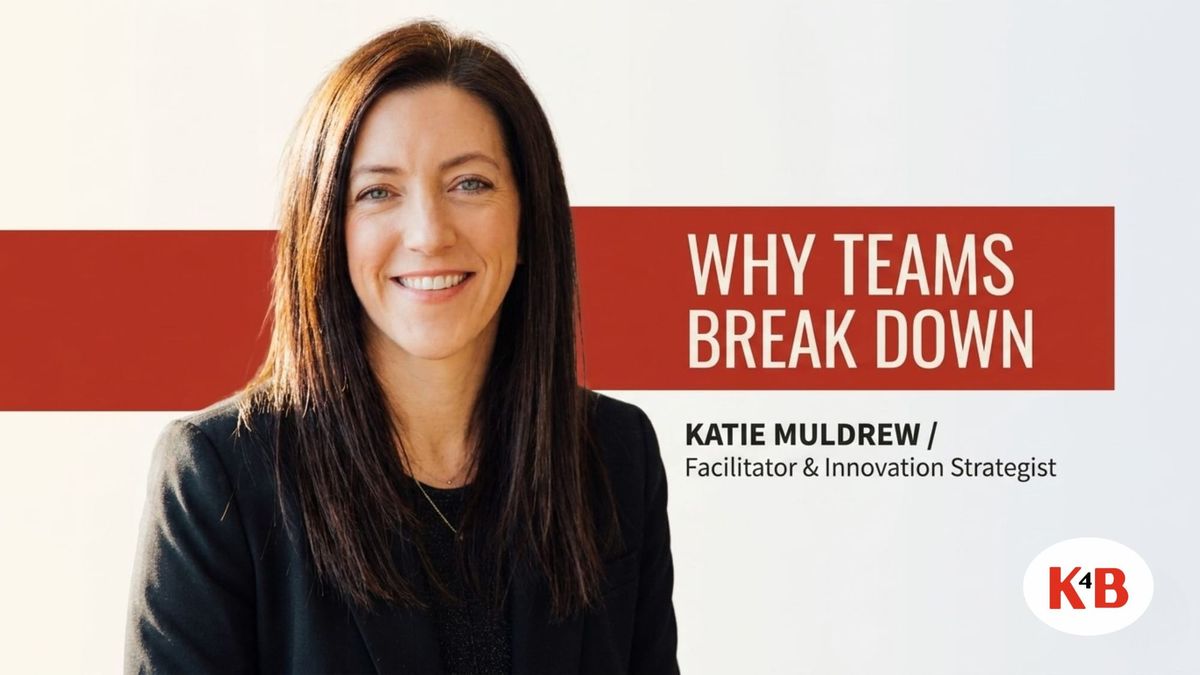
Host: Bernie Franzgrote
Katie Muldrew shares practical collaboration strategies, micro experiments, and leadership alignment tools to help teams stop struggling and move forward.
GROWTH CATEGORY: Leadership & Ops
Brought to you by Profit10™, Gentry Learning, and Canada Growth Network.

Profit10 SnapShot
Take the free - 5 minute - Profit Snapshot and find out what's really holding your business back. Ten questions. Real clarity. No cost.
Your team is stuck. Meetings keep happening. Nothing keeps moving. And the harder you push, the quieter people get.
That's not a talent problem. That's a systems problem — and it's more common than most leaders want to admit.
Katie Muldrew has spent years helping teams get unstuck. As founder of the Collective Knot, she works with public and private sector organizations to build the trust, alignment, and practical tools that turn a frustrated group into a focused team. Her background spans civil engineering in Ireland, the Christchurch earthquake rebuild in New Zealand, and innovation leadership at WorkSafe New Zealand. She now works across Atlantic Canada, Ontario, and beyond.
Watch the full conversation here:
WHO THIS IS FOR
SMB owners / Team leads / Project managers / Leaders building better systems / Anyone who has ever sat in a meeting where nobody is on the same page
Key Lessons
1. Purpose is the structural foundation of trust
In Christchurch, the rebuild program leader said the same thing at every meeting: they were there to build resilient infrastructure that gave people confidence in the future of their city. It was on the walls. It was in every conversation.
And over time, companies that were natural competitors started sharing software, ideas, and expertise. Not because they were told to — because the purpose was bigger than the competition.
For any team, the lesson is simple. If people don't know why they're doing the work, alignment is guesswork. Say the purpose out loud. Say it often. Let it be the thing that pulls people past their silos.
2. Micro experiments reduce risk and build momentum
Think of the aviation one-in-sixty rule: one degree off course means one mile off target for every sixty miles traveled. Small corrections, made early, keep everything on track.
That's what a micro experiment is. Talk to one customer. Build a rough wireframe. Run a short prototype session. The goal isn't a finished product — it's a signal. Are we heading in the right direction? Adjust. Test again. Keep moving.
For teams with full workloads and limited bandwidth, this approach makes innovation feel manageable instead of overwhelming.
3. The word "innovation" might be killing your momentum
At WorkSafe New Zealand, Katie's team stopped using the word entirely. They replaced it with "better work." The reason: innovation energizes some people and shuts others down. Better work is something everyone can connect to. It's smaller. It's safer. And it actually gets done.
If your team freezes when you say "let's innovate" — try changing the language before you change the process.
Practical Steps
1. Repeat the purpose at every team touchpoint. Not once a quarter. Every meeting. Put it in writing. Make it visible. Watch what happens to the energy in the room over the next four weeks.
2. Design one micro experiment this week. Pick your riskiest assumption about a current project. Now ask: what is the smallest thing I could test to find out if this is true? Do that first. Build later.
3. Map the process before the next cross-department meeting. Bring a whiteboard or use a simple online tool. Walk through every step of the process and ask each department: where do you come in? Where do the handoffs happen? Where does it slow down? Make the invisible visible.
About the Guest
Katie Muldrew is a facilitator, innovation strategist, and the founder of the Collective Knot. She helps leaders and teams align around shared goals, communicate clearly, and move forward with confidence. With a background in civil engineering and human-centered design, she has worked across Ireland, New Zealand, and Canada — including a key role in the Christchurch infrastructure rebuild following the 2011 earthquakes.
She works with public and private sector organizations and is particularly useful at the start of a project — before misalignment has a chance to take hold.
Connect with Katie: LinkedIn | collectiveknot.com | katie@collectiveknot.com | @thecollectiveknot
Listen on Audio
Listen on Simplecast
Browse all episodes
Partners on this episode
Profit10™ — Take the free Profit Snapshot and find out what's really holding your business back. Ten questions. Real clarity. No cost.
Gentry Learning — Real estate education with Fred Crouch. Courses, active listings, an investor club, and a free newsletter.
Canada Growth Network — Real connections and a a robust CRM platform stack. $47 CAD/month. First month $1 CAD.
FAQ
Q: How do I know if my team needs a facilitator or just better processes?
If your team is quiet, spinning their wheels, or has tried the same fix more than twice without results — that's the flag. A facilitator helps you see what's invisible from the inside.
Q: What is a micro experiment and how long does it take?
A micro experiment is the smallest test you can run to validate an idea before committing to it. It could be a fifteen-minute conversation with one customer. It could be a rough sketch on paper. The goal is a signal, not a solution. Most micro experiments take a day or less.
Q: Can these tools work for a small team of two or three people?
Yes. Purpose, trust, and micro experiments are not size-dependent. A team of two with a clear shared goal and a habit of small tests will outpace a team of twenty with none of those things.
- Join Canada Growth Network $47 CDN gets robust CRM platform + Community
- Web Indexer – the quick install info chatbot that works 24/7
- Browse all episodes — K4B / ETW / CGN
- Search K4B episodes by topic
- Want to be a guest? Register here