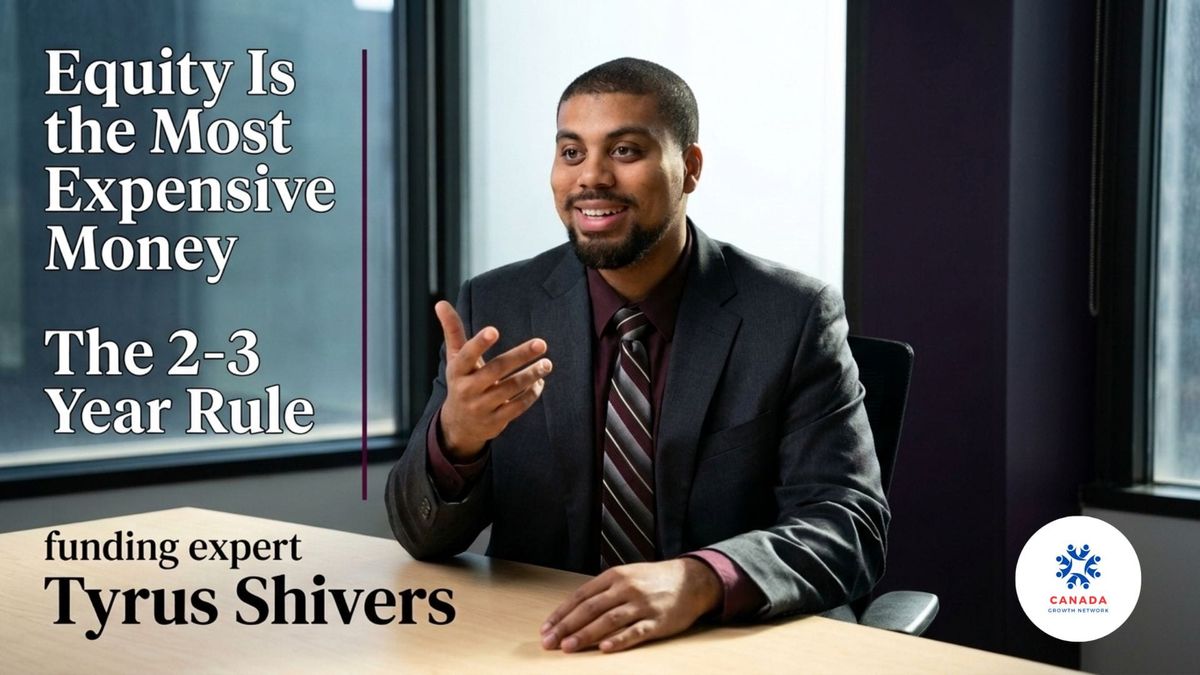
Equity Is the Most Expensive Money ~ The 2-3 Year Rule
Founder and investor Tyrus Shivers breaks down the ten-question fundability test and why equity is the most expensive money you'll ever raise.

Hosts: Percy Barr, Wayne Pratt and Bernie Franzgrote
Founder and investor Tyrus Shivers breaks down the fundability test, growing vs scaling, and why equity costs more than any loan.
GROWTH CATEGORY: Leadership & Ops
Brought to you by Canada Growth Network, Profit10, and Gentry Learning.
You've never been turned down for asking for too much. You've been turned down for asking for too little. Tyrus Shivers, founder and investor at Legacy Wealth Capital Group, learned that the hard way — and it changed how he raises money for good.
MASTER SYNOPSIS
Tyrus Shivers, founder and investor at Legacy Wealth Capital Group, breaks down what actually makes a business fundable. He walks through a ten-question fundability test and shows the real difference between growing a business and scaling a business — two things owners often mix up. He explains how founder dependency quietly lowers what a business is worth, and why clean finance habits matter more than a pitch deck. Tyrus uses a 170-point framework to fix weak systems and get owners ready for capital raising, whether that means a bank, an investor, or a buyer. He closes with a 90-day plan to build the boring financial habits that make a business worth buying.
Watch the full conversation here:
ANSWER CAPSULE
Most business owners don't know if their business is fundable right now. Tyrus Shivers, founder and investor at Legacy Wealth Capital Group, built a 170-point framework that fixes the systems investors actually check. Readers walk away with a ten-question fundability test and a 90-day plan to close the gap.
WHO THIS IS FOR
SMB owners / Solopreneurs / Corporate escapees / Leaders building systems
KEY LESSONS
1. Fundable is a condition, not a pitch. Nearly half of failed deals die in due diligence, not on price. Tyrus's ten-question test tells you honestly where you stand — before you ever walk into a room with money in it.
2. Growing and scaling are different games. Growing means revenue and costs rise together — most businesses stay in the red for years doing it. Scaling means revenue outruns cost, margin expands, and each new dollar costs less to serve. One gets financed with debt. The other attracts equity. Confuse them and you raise the wrong kind of money.
3. Founder dependency has a price tag. Owner-dependent businesses trade one to two turns of EBITDA below management-run peers — a 20 to 40 percent valuation discount. Tyrus's fix: take two weeks off, tell no one, and write down what breaks.
PRACTICAL STEPS
- Run the ten-question fundability test this week and count your yeses honestly.
- Separate every business dollar from personal spending, and move to accrual-based books.
- Close your books every month, and build three schedules: revenue by customer, aged receivables and payables, and gross margin by line.
ABOUT THE GUEST
Tyrus Shivers is the founder of Legacy Wealth Capital Group — where he uses a 170-point framework to prepare founders for capital-ready growth. Connect: LinkedIn · Instagram · YouTube
LISTEN ON AUDIO
Listen on Simplecast
Browse all episodes
PARTNERS ON THIS EPISODE
- Canada Growth Network — business connections plus a robust CRM, $47 CAD a month.
- Profit10 — a free diagnostic on what's driving or limiting your business value.
- Gentry Learning — real estate education and investor training with Fred Crouch.
FAQ
What makes a business "fundable"? It's a business that can produce clean financials, doesn't depend entirely on the owner, and has a documented process for the revenue that matters most.
What's the real difference between growing and scaling? Growing means costs rise with revenue. Scaling means revenue rises faster than cost, and margin expands as you go.
Why is equity the most expensive money? Because you're selling part of the upside permanently, often to solve a problem debt or better collections could have fixed temporarily.
- Join Canada Growth Network — $47 CDN a robust CRM + Community
- Web Indexer — Quick install chatbot, info 24/7 for visitors
- Browse all episodes
- Search K4B episodes by topic
- Want to be a guest? Register here
- Attend the Monday Power Hour free