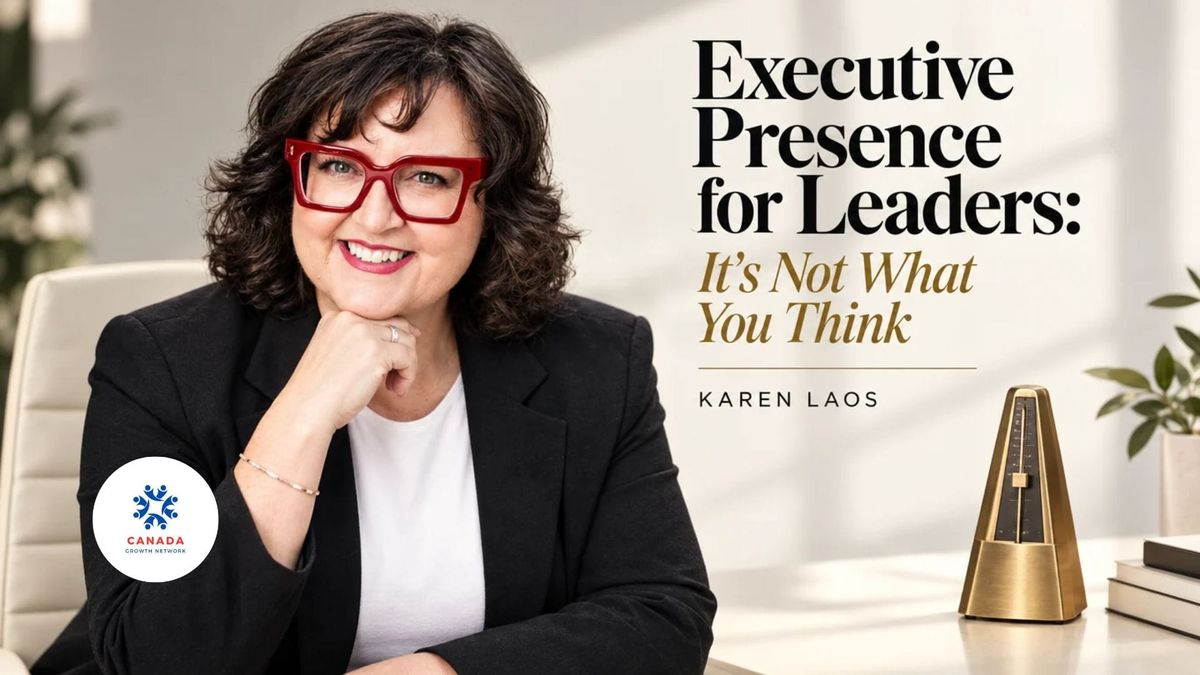
Executive Presence for Leaders: It's Not What You Think
Executive presence isn't charisma. Karen Laos shows leaders how to speak up, hold a room and name their price with confidence.

Hosts: Percy Barr, Wayne Pratt and Bernie Franzgrote
Executive presence for leaders: Karen Laos on the Canada Growth Network Power Hour shares how to drop weak words, hold eye contact and name your price.
GROWTH CATEGORY: Leadership & Ops
Brought to you by Canada Growth Network, Profit10™, and Property Wizard Podcast.

You know the answer. You've done the research. Then the meeting starts, and the words won't come.
Karen Laos has been there. She once froze in a boardroom meeting built around her own expertise. Today she helps leaders stop holding back and start speaking with authority.
Karen Laos is a communication expert who helps leaders build confidence and stop asking for permission to speak up. In this Canada Growth Network Power Hour, she shares the day she froze in a boardroom, at a time when she was also speaking on stages at Google and Netflix. The root cause was people pleasing, and that moment led to her Confidence Cocktail framework. It covers identity, mindset, executive presence and the direct ask. Karen shows how small words like "sorry" and "I think maybe" weaken your business communication. She explains why steady eye contact and well-timed pauses build trust, in person and on Zoom, and how to quote your price without backing down. This episode is for business owners and leaders who know their stuff but hold back when it counts.
Watch the full conversation here:
Executive presence is not charisma or a gift you're born with. Communication expert Karen Laos, who has spoken on stages at Google and Netflix, breaks it into skills people can see: eye contact, the pause, a clear point and a direct ask. Leaders who practise these habits speak up sooner, sound more credible and win more deals. (57 words. Remove the label before publishing.)
Who This Is For
SMB owners, solopreneurs, corporate escapees and leaders building systems. Especially if you know your stuff but hold back when it counts.
Key Lessons
How do I stop apologizing so much at work?
Start by noticing how often you say "sorry" when nothing is wrong. Karen jokes that it's a very Canadian habit. Each extra apology tells people you're in the way. Swap it for "excuse me," or better, a thank you: "Thank you for your patience." Do the same with shrink phrases like "I'm no expert, but" or "I think maybe we should." Say the point without the cushion.
Karen grew up hearing her mom open every church phone call with "I'm sorry to bother you." She had to unlearn it.
How long should you hold eye contact when presenting?
Karen says aim for three to five seconds per person when you present in a room. Over coffee, people look at each other for about seven to nine seconds before glancing away. Most presenters do the "eye dart," scanning the room and looking up or down to think. Settle on one person, finish a thought, then move on. On Zoom, look at the webcam, not the faces on your screen.
Karen follows an 80/20 rule. Eighty percent of the time she looks at the camera. The other twenty percent is grace: a quick glance to read the room.
How do I quote my price with confidence?
Say the number plainly and stop talking. Karen once quoted a $200,000 deal by simply saying "200K." The client later told her that certainty was why they wanted to hire her. Another provider had sent a long list of options. If the silence gets long, ask "How does that land with you?" If they say it's high, try: "I recognize I'm higher than most. Is that a deal breaker?"
That question led one HR leader to say "Absolutely not" and come back with a budget and a plan to make it work.
Practical Steps
- Record your next video call and watch it back. Look for crossed arms, fidgeting and statements that end like questions.
- In your next meeting, speak in the first ten seconds, or say "Here's my vote" instead of "I think maybe."
- Take Karen's free Powerhouse Presence Profile to find your credibility gap.
Bernie's Take
I make a lot of introductions. Some turn into business. Most don't. Karen helped me see why. When I introduce two people, I'm lending them my trust for about ten seconds. If the person I introduced opens with "I'm no expert, but" or a long list of options, that trust leaks out fast. The ones who win say what they do, name the price and ask a direct question. That's not charisma. It's a habit. So here's my vote: before your next introduction, write your ask in one sentence. Then say it with a period, not a question mark.
About the Guest
Karen Laos is the founder of Karen Laos Consulting, with more than 25 years advising executives on how they communicate. Connect: LinkedIn · Instagram · YouTube · Speak Up and Be Heard
Listen on Audio
Partners on this episode
- Canada Growth Network - A business community plus a robust CRM, $47 CAD a month.
- Profit10™ - Take the free Profit Snapshot. Ten questions, a clear read on what's holding your business back.
- Property Wizard Podcast - Real estate and wealth building made practical, with Fred Crouch.
FAQ
What is executive presence?
Karen says most people describe it with labels like charisma, gravitas and confidence. That's too vague to act on. She breaks it into behaviours people can see: connection through eye contact, facial expression, energy from posture, movement, gestures and voice, and credibility through the pause. Because it's behaviour, it can be practised.
How do I speak up in meetings when I have self-doubt?
Speak first. When someone asks "Who wants to kick it off?", take the first ten seconds. Karen notes that research links speaking up with being seen as a leader. If sharing an opinion feels hard, use her phrase "Here's my vote." It's direct, it's diplomatic, and it assumes everyone gets a vote. If you lead the team, let others go first.
How do I stop rambling when I talk?
First, notice you're doing it. Then stop, pause and say out loud, "My point is this." That gathers your thoughts and brings people back. Karen, a self-described recovering rambler, also uses BLUF, a US military term for "bottom line up front." Lead with the point, then add detail only if people need it.
What does the Mehrabian study say about communication?
Albert Mehrabian, author of Silent Messages, looked at three parts of every message: verbal (words), vocal (tone) and visual (body language). His famous finding is that only 7 percent of meaning comes from words when the signals don't match. Karen is clear that this applies to mixed messages, not all speech. If your words say "excited" and your face says "bored," people believe your face.
How do I make a direct ask?
Drop the word "if." "If you'd like to learn more" is passive. "Would you like to learn more?" is a direct ask. Keep it simple, give it a direction and add a deadline when you can. Karen also ties the ask to a bigger purpose. "Do you want to be part of a movement empowering women?" landed far better than "Can you speak at my event?"
What is the Confidence Cocktail?
It's Karen Laos's framework for clear, compelling and credible communication. She pictures a cocktail glass. The stem holds eight ingredients, including identity, mindset, presence, message and negotiation. Courage sits at the bottom of the glass, because nothing happens without it. Karen jokes she doesn't drink, so for her it's a mocktail.
- Join Canada Growth Network - $47 CDN a robust CRM + Community
- Web Indexer - Quick install chatbot. Info 24/7 for visitors. Install it today.
- Browse all episodes (K4B / ETW / CGN)
- Search K4B episodes by topic - this uses that Web Indexer!
- Want to be a guest? Register here
- Attend the Monday Power Hour free
Full transcript
Karen (00:05)
I'd like to start first with my story of when I was in a boardroom many years back, completely tongue-tied. My boss shut down the meeting. It was so bad. And the entire meeting existed because of me and my expertise.
Ironically, at that time in my life and career, I was on stages at places like Google and Netflix and Sony and all kinds of places. And I couldn't get the words out in that particular moment. And my boss was so kind though, she pulled me aside after and she goes, Karen, you didn't trust your gut. You could have just tabled the meeting. And in that moment I thought of two things. Number one, what? I could have tabled the meeting? That was an option. And then the bigger
Thing I thought though was why do I keep asking for permission? And I realized that I through a lot of self reflection that I had been asking for permission to speak up most of my career. And I figured I said, I've got to get to the root of my challenge here. And once I got free from that, took a number of years, but I realized, my gosh, I want everybody to be free from this.
And so this holds not only my professional expertise for my entire life has been in how to help people present themselves better through communication, but it also represents a lived experience of being tongue tied at certain moments. And I realized mostly the root of my challenge was I grew up as very much a people pleaser. You make sure everybody else is comfortable and you don't speak up because the authority tells you if.
you listen to authority and my boss had asked me to present on this topic, but I don't think she really cared that much about what I was doing. But I felt like I had to figure it out and I didn't agree with it, but I didn't say anything in advance. So all of that to say that it's so important to speak up when you believe it is the right thing to do. And I wish I had done that much sooner because when it came game time as you if you will
I couldn't get the words out. winning in the moments that matter. So if we go to my framework, most people come to me because they want to be a clear, compelling, and credible communicator, which is at the top of this cocktail glass. And pick whatever cocktail you want. The irony is I don't even drink. So this for me would be a mocktail. But it's all about communication in the stem of the glass.
And there's eight ingredients to this that I have found. And we're not going to cover all of them today, but we'll touch on identity, mindset, and your presence as well as the message. We will touch a little on negotiating because I promised that we would around how to make a direct ask. But if you look at these ingredients, what I have found is that these are the core ingredients that really help people be that clear, compelling, and credible communicator.
But you'll also notice that at the bottom of the glass is courage, because nothing is gonna happen. We won't take action if we don't have courage to do it. So let's start with what I call the handshake moment. What experience do you create for people? So I want to ask you, when you think about it, first of all, we're all creating an experience. The question is, is it good one or not? And what I'm wondering is, how do you want people to feel in your presence?
So drop that in the chat or feel free to unmute. Either how do you want people to feel around you? Or here's another question that often we don't think about. How do you want people to talk about you behind your back? What do you want them to say about you? If we think about what you want to be known for, what your reputation is.
go to public speaking.
And what that looks like. And maybe that's a stage or or you're presenting standing up to somebody or even seated at a meeting. And that is absolutely true. And at the same time, I want to encourage each each of us to remember that every time you open up your mouth is an opportunity to influence. People are paying attention all the time, even when we're not opening up our mouths.
the fact that we have facial expressions half the time we don't often realize what they are communicating. And so I wanna remind us that we're always public speaking and make a little little joke here that is there really such a thing as private speaking? unless you're in the shower or you're talking to yourself in the car, most of the time we have some type of audience. So I never want anybody that goes through any of my material to think I'm just gonna put that on a shelf.
Karen's what Karen said was great. We'll put that over here on a shelf and then I'll bring it out when I actually need it when I'm presenting. So that's the first thing I want to focus on related to in the Confidence Cocktail. This would be under the umbrella of identity. What is your identity and how is that communicated into the world? Another part of this now with the cocktail is the mindset component, the self-doubt that creeps in for most of us on some level.
Not everybody has it in different forms, but I do think it's an interesting statistic that I recently heard that forty-nine percent of adults identify as people pleasers. And that doesn't always mean it's connected to doubt, but usually, and I'll share in my own experience, boy, I've worked a lot of years on trying to just be focused on what I need and what I want. Of course.
Want to be cognizant of people around me, but not at the expense of my own well-being. And I've I've read a really great book called The Courage to Be Disliked. If any of you are interested and that sounds like a good book, boy, I would highly recommend it. It's very, very good. So that's where doubt has.
crept up for me of I have to make sure everybody else is taken care of and then it makes has made me doubt myself, thinking everybody else knows better than I do.
And here are some ways that we actually minimize ourselves with language. Has anybody said any of these or some version of this? Thank I'm no expert, but or I think maybe we should, you know, we we use language that diminishes our credibility. And number three,
I would definitely recommend, I know it's very Canadian to apologize unnecessarily. So I'm sorry, I'm sorry. And so what I would recommend is simply replacing it with excuse me, starting there. But
speaker-5 (06:26)
.
Karen (06:27)
there may not even be a need to say excuse me, but if you really wanted to, thank you for your patience. Thank you for waiting for me, having a different frame around that.
I grew up with a mom who wrote who made a lot of phone calls for our church and getting volunteers and every phone call was I'm sorry to bother you. I'm sorry to bother you. I mean that her I heard that growing up the whole time. So yeah.
Well, let's look at some alternatives, some better alternatives. That connects to a point I've been thinking about. Here's what I'm seeing. One thing to consider or I recommend. The last one is my favorite because it's what I taught myself and other people seem to like it. And here's my vote is something I started doing because
When I was working as an executive in a company, my boss said, You always come to meetings with all the research, but then you ask us first what we think, and you rarely share your opinion. And she said, I want to know what you think. And I will tell you, that was hard for me at first because I wasn't accustomed as a kid, again, the people pleasing and all of that, that to share my opinion. And so I started saying, Here's my vote.
And what I like about it is that it's direct, it's diplomatic, and it also assumes that everybody gets a vote and has a vote. So that's a a way that I use to warm myself up to that. Another tip I have is speak first. those moments of key real estate for the first 10 seconds of most meetings when somebody sells says, who wants to kick it off? Now this is assuming you are not leading the meeting, then take that.
Because research tells us that the people who speak the most are the leaders and the ones to follow. So this is one of the simplest, even though it can often take the most courage because it can feel awkward to be the one to jump in, especially if we have been socially conditioned to wait for everybody else to go first. So you've got to know best. The only time I don't recommend this is when you're leading a team and you want them to speak rather than you speaking all the time.
So let's talk about your presence. So I have some research I wanted to share with you. And some of you may have heard these numbers before. They come from Albert Mehrabian, who wrote a book called Silent Messages. And he wanted to figure out what holds the most weight when you communicate. And he determined that there are always three components present. And I'll just define these to make sure we're on the same page. Vocal is how you sound, the tone.
Visual is your body language, what people see of you and your facial expression. And then verbal is the content. So words only. And they equal 100%.
Okay, let's do a quick exercise and then I'll give you the answers. So make the peace sign with your hand, please, and put it in front of you, above your head, to the side, in front of you again, above your head, and on your chin. On your chin. On your chin.
I'm intentionally confusing you. And you all just proved the study for the most part. let me let me show you the right answers. I love doing that exercise because usually eighty percent follow along with me. So here's the numbers.
Now, this doesn't mean that only seven percent of what you say matters. That would be awful. But these numbers relate to an inconsistent message. So similar to what we've already been discussing, when your body language and your facial expression do not match the way that you're saying it and the words, then it's not going to be heard. So it would be the same if I started today and said, Thank you, Bernie. I'm really excited to be here. We're gonna have a great
Great session. You'd go, what? Who is this person? Why did Bernie agree to bring her on? So I bring this as context for what we're focusing on next because if content is strong, but delivery is off, you sound unsure and then people doubt and lose trust. You rush, people tune out, you shrink physically, people question authority. So many things around your presence. But the beautiful thing is that we can do something about it.
And if you ask anybody what executive presence is or leadership presence, you'll you'll likely hear the same three words charisma, gravitas, confidence, but those are just labels. And if I could tell if I had a dime or a a a dollar for every person that told me, my boss told me now, I know most of you are business owners, if not all, but the people that have been shared that their boss told them they have exec they need executive presence help, but
didn't show them how to do anything. It's so subjective. And in fact, I was on a team researching this at one point in my career, and we asked an executive vice president at one of the largest companies in the world how she would define it. And she paused for a very long time. And then she goes, I don't know, but I know it when I see it. And I'm thinking, an EVP at an ex I mean, at a Fortune 500.
deciding who is rising and s and stalling based on something she can't even define. That's pretty that's pretty concerning. So that's why I am in business and each one of these maps to a behavior that you can see. We won't go through all of these in detail, but I do want you to know just quick I'm gonna share quickly with each of these and then we'll walk through a few. So connection is really mostly your eyes. I say mostly because they're all intersected on some level.
But mostly connection comes from eye contact. And when we are connecting with somebody in person, let's say over a bagel or a coffee, we're likely looking at each other for about seven to nine seconds before one of us looks away. Any longer than that, it would be a little bit creepy or awkward. So, but we're not even thinking about it. So when you take that to a presentation in person, we'll talk about Zoom in a minute.
The goal is three to five seconds per person to have the optimal level of connection. That's what the research shows. Most of us, though, do the eye dart where we look around, we scan the room, we look up to think and down to think. That solid three to five seconds per person is absolutely critical if you want that connection. And you will absolutely stand out. Now that's in person. With Zoom, you want to look at the webcam.
Now, for me right now, a wonderful face is in the right hand corner of my screen in the bottom. And maybe I'm thinking, I'm connecting with her. Yes, I'm so glad you shared that. But notice it just looks like I'm looking at the floor. But if I look at the webcam, that's harder for me because what I'm looking at right now is right above the slides where it says your presence. So I'm not seeing anybody at this very moment. But
This is how I know that you're going to have an optimal connection from me. And what matters is our audience, not us. Now I always say follow the 80-20 rules. So 80% of the time, do the thing I'm talking about. That twenty percent is that grace. So, you know, of course I'm gonna occasionally look down and see the people's facial expressions, but just a glance and then I'm gonna come back and spend most of my time on the camera.
So let's let's break down a few of these. So I wanted to mostly focus on connection because that's really the number one behavioral skill. ability is facial expression. Energy has three components, which we'll talk about, but essentially it's posture, movement, f posture, wait a second, up posture, movement, gestures, and voice. So there are four. And then credibility is mostly the pause, but it does connect to the voice. Again, they're all connected.
So let's let's jump in here. I've got three tips for you. Be compelling. How you show up.
speaker-4 (14:14)
means impact.
Karen (14:15)
So get feedback. If you haven't recorded yourself recently and watched it back, that's key. The watching it back. Definitely do that because that is such a great way to see and hear how you're coming across. And here's an example of two side by sides with gestures, stance, and posture. So as you're looking at this, you decide who would you rather watch? Who do you think is more engaging?
The one on the left or the one on the right? I probably don't need to even ask you to participate in this, but you can see such a difference. Notice the stance. A lot of times we tend to lean. Now they both have a great solid stance. But you'll notice obviously he's got the arms crossed, he's fidgeting. She's very deliberate and intentional in what she's saying.
Here's a still shot to see the difference there.
And look at these people. Would you would any of you want to be in a meeting with these people? But sadly, this is often how we come across when we are the ones in the then the meeting. We don't think that other people are watching us, but sometimes this happens. These are all my old coworkers, by the way, and they're all lovely people. But it's such a good example of what we often have no idea.
So number two is to be credible and make sure that you're speaking with authority. Too often we speak with that up speak where we end a statement with a question mark. So for example, if I were to introduce myself and say, Hi, I'm Karen Laos, and I'm originally from Minneapolis, but now I live in the Bay Area. You might think I sound friendly, but notice how difference it is different when I say, Hi, I'm Karen.
I am originally from Minneapolis, but now I live in San Francisco, or rather the Bay Area. All I'm doing is punctuating my speech and simply ending my statements with a period. We don't even think about that in when we're doing an email. We we forget when we tend to speak that punctuation goes out the window. So remember to make sure that you shake up your volume, your pitch, your pace, that you have that vocal conviction.
Nobody wants to listen to a monotone voice. And I'm sure that we don't want to come across with that monotone voice either. And so remember, pause to eliminate filler words also to help you with that vocal variety to s to show engagement. And also pause to eliminate filler words like so you know. And those are obviously very, very, very ideal to eliminate.
Pausing also helps you to think. And that leads us to tip three, which is to be clear. Bottom line up front, that is a term from the US military, and it's really powerful because so many times we tend to ramble. I'm a recovering rambler myself, as well as the data dump. We tend to just sometimes project an Excel spreadsheet onto a document when we're doing a PowerPoint presentation, or we tend to have that data dump.
when we are speaking as well. So the tip that I would recommend about rambling is to notice that you're doing it. So you have to have the emotional intelligence to notice it. And then stop, pause, and say out loud, my point is this. And that will help you to gather your thoughts. It will also bring people back. And then I've got one bonus tip for you here is to be direct when you ask for what you want.
So notice what's wrong with these. Whenever you start a sentence with the word if, it is most likely not going to be a direct ask. And when I was coaching sales teams, I remember we'd get people into pairs and they had one minute to pitch their idea to somebody else, and they had to end with a direct ask. And after all the pitches happened, I would ask them to raise their hands if they felt that they made a direct ask. And most people raised their hands.
But then when we watched it back on video, the truth is most of them were passive, like these. If you'd like to learn more. And as opposed to would you like to more learn more? Are you interested? So really, really powerful to have that direct ask. So make it simple and easy. Give it a direction as well as a deadline or a timeline, ideally, when you can.
So a couple other things here, and I know we're at time. So one of the things I've learned is when you are making an ask to someone else is to make it related to a bigger purpose. So this is a real example of a woman who was trying to get people to donate to a blood drive and she she was always leading with that and she wasn't having that much success. So we shifted it because I said, well, what would be helpful to you and to get people like tell me more about what donating blood does.
And she said, Well, they have an opportunity to be a hero in someone's life. So that's what she started leading with and she got a lot better results. And then one of my own examples, many years ago, I had 21 women speak at a summit that I was hosting. And I started with, Can you speak at my event? Which is all about me. It's not really that interesting. It's like why would they care? And when I started saying, Do you want to be part of a movement empowering women?
That created a whole different experience. So very, very, very different. And that got me more results as well.
I think it all goes back to you knowing your audience. At the end of the day, it's why would they care and what would you want to how could you find that out? Of course, that's asking those questions, being curious in advance, ideally. And I'd say it's again, it's one of those things where it's less about the words, but it's more about what is the intent and how are you also coming across with that? And so I know that isn't a specific like do this, this is an action item, but definitely making sure that
You do your research so you know what would work in the context of that audience. Because there might be times where you are going to say, like, if you're interested, because maybe it it doesn't need to be a direct ask. So I think it all goes back to what is your desired outcome from the conversation. And a lot of us aren't clear on what our desired outcomes are much of the time. That's another thing that I have learned and here.
Often, even on connection calls, when I I start usually with what would give you the most value out of this call or what are you hoping to get out of this? People just start talking and then they never answer the question. And I'm not gonna I'm not often gonna go back, but I did have a CEO once where I was a consultant say he wanted to meet with me because I was coaching as CFO, but I didn't know why he wanted to meet with me because I normally meet with a HR person.
So I started with great, so good to meet you. what would you like to get from this today? And it just immediately qu he just started talking and then did not get to the point. And then I brought it back and I said, I'd love to make sure that I give you what you came for today. Would you be willing to share what you get? You know, and he just he couldn't do it. I asked him twice and I wasn't gonna ask him a third time. So I had to infer what he wanted and I figured it out. But at the same time, sometimes even if you might know on the other end, it's
Clarity with both parties and speaking that clarity out loud.
really powerful story that was really powerful for my own learning. And it was one of the times I listened to my own advice, actually. So that's why I'm particularly proud of it. So I was pretty nervous to quote a $200,000 deal, but I did it when she said, Okay, this sounds great. How much is this gonna cost me? And I just said 200K.
Just like that. And do you know that the next she goes, okay, let me get back to you. When we had a follow-up call, she said, I want you to know that when you quoted your rate, she goes, First of all, you've been transparent with your fees all along. And when you quoted that specific rate, I realized that is exactly what I need from my team. That's exactly why we want to hire you. Because of your certainty. And
I will tell you, I and she said, another provider shared all this detail and all of these options and I didn't say anything until I hung up, of course. Then I went, That used to be me. I used to be the one that gave all the options and if you don't have budget, okay, well we'll make it work. What do you have? And all this negotiating and it was a lack of certainty in just stating the fee and that being it. So that was a very powerful lesson to me.
Is that even in the way we operate as business people, we are affecting how people experience us.
phrase that I love is how does that land with you? And I know that our the you know what you always hear in negotiation is to pause and I definitely see the value in that, in the silence. And I will share that a few years ago I had another negotiation with an HR person to be potentially coaching their CFO. And I don't even know where this next phrase came out of in my mouth, but two things happened again that I was
really like, wow, where did that come from? Because I did not train myself to say it. But after I shared my rate, she paused for quite a long time and I didn't say anything. And then I finally thought, okay, I'm going to say something. So I said, how does that land with you? And she said, well, I'm going to be honest, Karen. It's a lot more than the other coaches we've been looking at. And then I said, I recognize I'm higher than most. And I just said it like that.
But then I followed it with, is that a deal breaker? And she said, Absolutely not. I I know we want to make sure that this is a fit. And I'm confident that if it's the right fit and you meet her and she wants to work with you, we'll work it out. And they came back and she was, it was one of the best business experiences I've ever had because it was a $30,000 contract. And she came back with, okay, here's what I have. I have 25. That's it. How do we need to scale?
for this to work. It was so respectful and polite. It was so I I've never had anybody say it to operate in that same way. It was really just very beautiful.