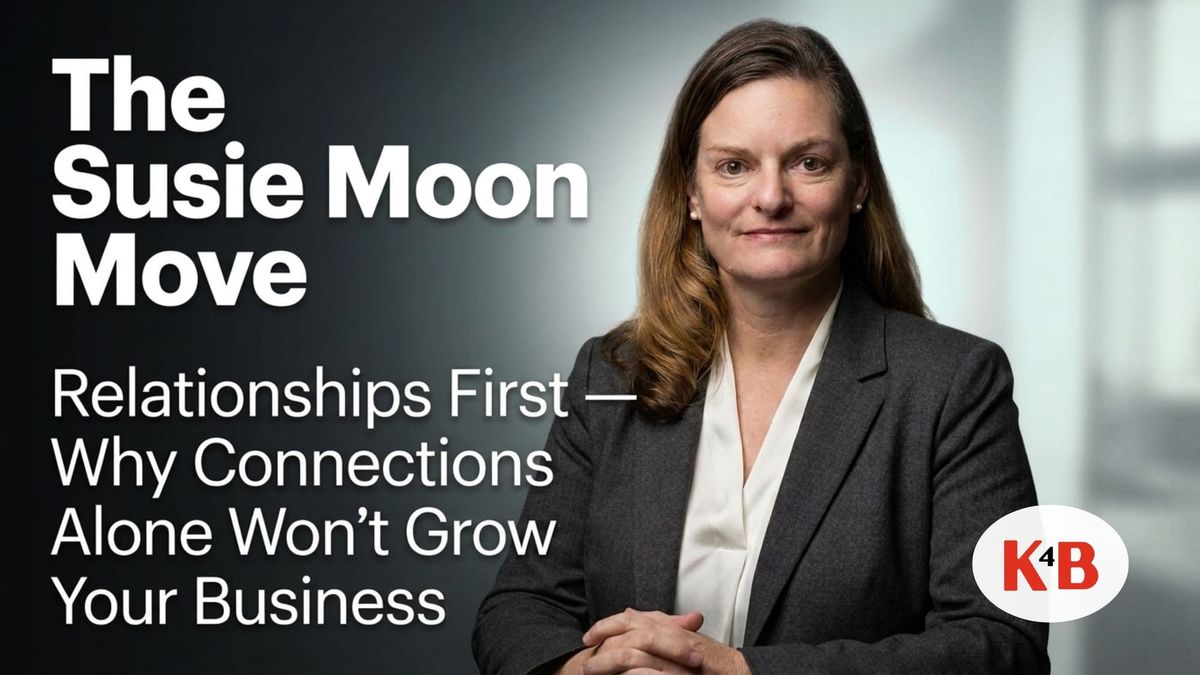
Relationships First — Why Connections Alone Won't Grow Your Business
Master connector Susie Moon breaks down why collecting contacts never converts — and how a relationship-first approach builds the referral partners who talk about you when you're not in the room.

Host: Bernie Franzgrote
Master connector Susie Moon on why authentic networking builds referral partners — and what actually turns a contact into a client.
GROWTH CATEGORY: Networking & Community
Brought to you by Gentry Learning, Canada Growth Network, and vidIQ.

Real estate education built by Fred Crouch. Courses, active listings, an Investor Club, and a free newsletter.
You've been to the events. You've sent the follow-up emails. You've got a contact list full of people who kind of know you.
And yet the referrals aren't coming.
Susie Moon has spent 30 years figuring out why — and more importantly, how to fix it. She's the founder of Susie Moon Consulting, a boutique visibility agency that gets thought leaders and small business owners into rooms they can't get into on their own. She's known as a master connector and a super sleuth. She doesn't just make introductions — she studies people, reads rooms, and opens doors most people don't even know exist.
Watch the full conversation here:
ANSWER CAPSULE:
Most business owners collect contacts but never convert them into referral partners because they network transactionally. Susie Moon, a 30-year master connector and founder of Susie Moon Consulting, teaches a relationship-first approach — give before you ask, leave a memory, and follow up with intention — that turns strangers into referral sources.
WHO THIS IS FOR
SMB owners / Solopreneurs / Corporate escapees / Leaders building referral-based businesses
Key Lessons
1. Giving first is the whole strategy.
Most people show up to a networking event looking for something. Susie shows up looking for someone she can help. That's the entire shift. Send someone an article that made you think of them. Introduce two people who should know each other. Ask how you can help before you ask for anything in return. Susie calls it her Midwest methodology — give first, and people feel a natural pull to reciprocate. That reciprocity is where referral relationships are born.
2. The best networking stories have nothing to do with business.
Susie's dad used to pack old underwear on road trips and throw it away at hotel checkout so he wouldn't have to carry it home. She told that story at a networking event. Three years later, a woman she met that day still asks about her dad. The lesson: people don't remember your pitch. They remember how you made them feel. The goal isn't to be the most impressive person in the room — it's to leave something in someone's mind that makes them think of you when a referral opportunity shows up.
3. Vulnerability builds authority faster than confidence does.
Most people walk into a room trying to look like they have it together. Susie says the opposite works better. If you're struggling, say so. Ask for help. People want to support each other — and the moment you drop the performance and get real, the conversation becomes something worth remembering. Being the most polished person in the room and being the most referred person in the room are not the same thing.
Practical Steps
1. Before your next networking event, contact the host.
Ask who you should meet when you're there. Get one name. Walk in with a purpose and a person to find. This one step removes most of the anxiety and gives you a reason to start a conversation.
2. Prepare one non-business story.
Something personal, something memorable, something that reveals who you are without pitching what you do. Susie's underwear story works because it's specific, human, and a little funny. Find your version of that.
3. Follow up once a month with your strongest connections.
Not a newsletter. A direct message. Ask what's new. Ask what you should say about them when you refer them. Ask how you can help. That's the whole follow-up system. — Descript is the tool I use to clip and repurpose the best moments from conversations like this one. —
About the Guest
Susie Moon is the founder of Susie Moon Consulting — a boutique visibility agency helping thought leaders and experts get in front of the right audiences. Connect: LinkedIn · Instagram · YouTube · Facebook
Listen on Audio
Partners on this episode
Gentry Learning — Real estate education built by Fred Crouch. Courses, active listings, an Investor Club, and a free newsletter.
Canada Growth Network — Real referral-based connections and a full CRM automation suite for SMB owners. $47 CAD a month.
vidIQ — The YouTube growth tool Bernie uses on every episode of this show.
FAQ
Q: How do you know if a networking group is the right fit before you commit to it?
A: Research it before you walk in. Look at past social media posts from the group. Find one person who has attended and ask them directly — do the right people show up, and does it feel like a room where you belong? One bad session isn't a verdict. But if you leave two sessions in a row with nothing worth following up on, the room isn't right for you.
Q: How often should you follow up with a new connection?
A: Once a month is enough for a strong connection. The follow-up doesn't need to be elaborate — send an article, ask what's new, or ask what you should say about them when you refer them. The goal is to stay on their radar in a way that feels personal, not automated.
Q: What do you do when imposter syndrome hits at a networking event?
A: Say so. Tell the person next to you that you're not great at this. Ask for help. Most people in that room are there because they want to connect — and the fastest way to connect is to be honest about where you are. Vulnerability at a networking event is a strength, not a liability.
- Join Canada Growth Network — $47 CDN/month. Real referral-based connections and a full CRM suite.
- Web Indexer — Quick install chatbot. Info 24/7 for your website visitors.
- Browse all episodes — K4B, ETW, CGN
- Search K4B episodes by topic — powered by the Web Indexer
- Want to be a guest? Register here