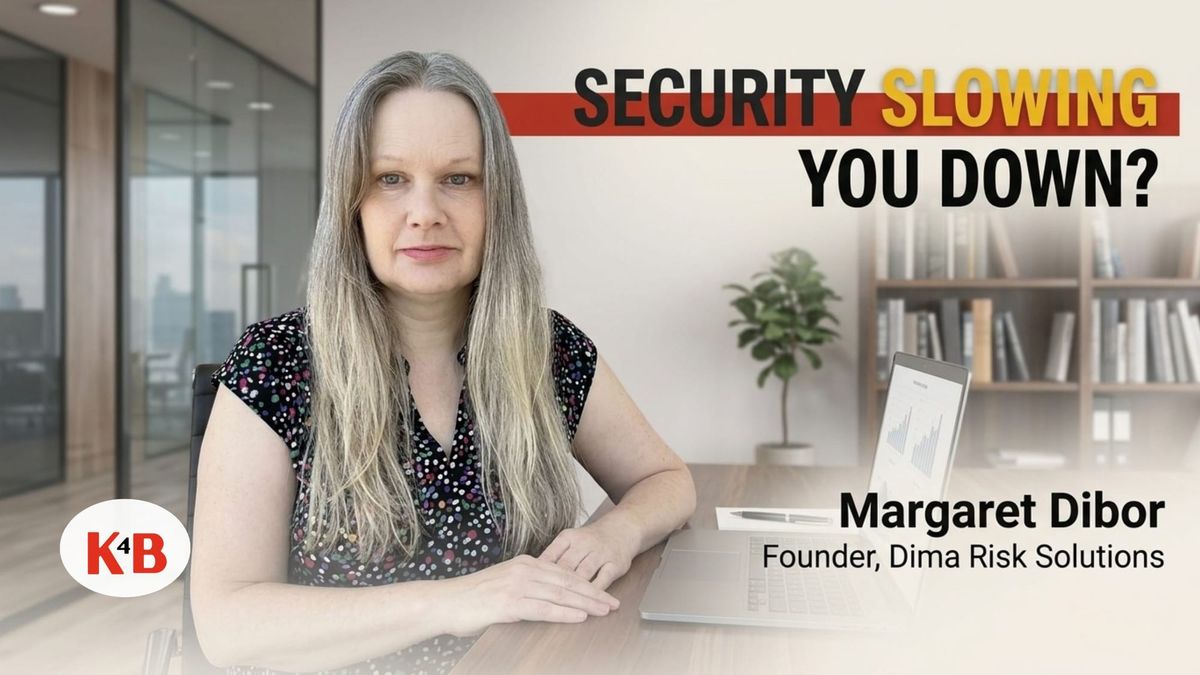
Security Slowing You Down? Here's Why | Margaret Dibor
Margaret Dibor on why most small businesses are over-equipped but under-protected. The calm, practical roadmap to cybersecurity for SMB owners.

Host: Bernie Franzgrote
Margaret Dibor on why small businesses are over-equipped and under-protected the calm guide to SMB cybersecurity.
GROWTH CATEGORY: Cybersecurity & IT
Brought to you by Sterling Grace Technologies, Canada Growth Network, and @Hive.
Most small business owners feel the same tension every week. The thing protecting your business is also the thing slowing it down. Margaret Dibor has spent 20 years on both sides of it. She is here to turn the fear conversation into a growth conversation.
Watch the full conversation here:
Who This Is For
SMB owners, solopreneurs, corporate escapees, and leaders building systems — especially in health tech, fintech, healthcare, and finance.
Key Lessons
1. Resilience matters more than defence.
Modern businesses are not closed systems. Data moves across vendors, jurisdictions, and AI tools. The job is no longer to wall everything off. The job is to design for openness and stay resilient when something fails. Margaret learned this inside the NHS — one of the most complex data environments in the world.
2. Tools without awareness still leave the door open.
Most SMBs are over-equipped and under-protected. They bought the software. They ticked the boxes. They still got breached. The reason is almost always the same. People paste sensitive data into AI tools. Vendors mishandle. Nobody is watching. The fix is awareness culture inside the business, not another subscription.
3. Trust is the SMB currency.
A large enterprise can survive a breach. A small business often cannot. One bad week erases years of relationship building. Owners who treat data protection as a growth investment keep the relationships that built the business in the first place.
Practical Steps
- Map your real risk profile this month. Write down what data you hold, who has access, and where it lives. That single page is the start of every serious cybersecurity plan.
- Build to the strongest law in your operating footprint. If you serve clients in Quebec, the EU, or California, build to those rules. The weakest law is a trap.
- Train your team on AI tool use before adding more tools. Once sensitive data goes into an AI tool, you cannot get it back. Awareness costs less than a breach.
About the Guest
Margaret Dibor is the co-founder and Chief Information Security Officer at Dima Risk Solutions in Vancouver. She has 20 years of experience across telecom, education, healthcare, and government — including projects with the NHS in England. She sits on the board of the ISACA Vancouver Chapter. She helps small and mid-sized owners turn cybersecurity from a fear conversation into a growth conversation. Connect with her on LinkedIn.
Margaret is opening a two-month pilot of her risk management platform right now. It is built for owners in health tech, fintech, healthcare, and finance who handle sensitive data and want a calm, practical roadmap before something goes wrong.
Listen on Audio
Listen on Simplecast
Browse all episodes
Partners on this episode
- Sterling Grace Technologies — cybersecurity, IT, and business continuity for Canadian SMBs.
- Canada Growth Network — business connections plus CRM, $47 CAD/month.
- @Hive — real-world business networking, $99 CAD/year starter membership.
FAQ
Q: What is the difference between cybersecurity and data protection?
Cybersecurity is the technical defence layer. Data protection is the broader discipline — how you collect, store, share, and respect data across your business. Margaret treats data protection as the parent. Cybersecurity is one part of it.
Q: When should a small business bring in expert help?
Margaret uses two triggers. The first is volume and sensitivity of data, not company size. A two-person health tech firm can carry serious obligations under regulations like GDPR. The second is timing — bring in help before scaling, before client acquisition jumps, or before you sign a big contract.
Q: What about AI tools — are they safe?
They are useful, but they need rules. Once you paste sensitive data into an AI tool, you cannot retrieve it. Margaret's advice is to build awareness culture first, then introduce the tool. Not the other way around.
- Join Canada Growth Network = $47 CAD gets you CRM + more
- Web Indexer - search bot for your website
- Search K4B episodes by topic
- Want to be a guest? Register here
K4B Acknowledgements
Special thanks to Willie Nichol in Scotland for the introduction to Margaret.