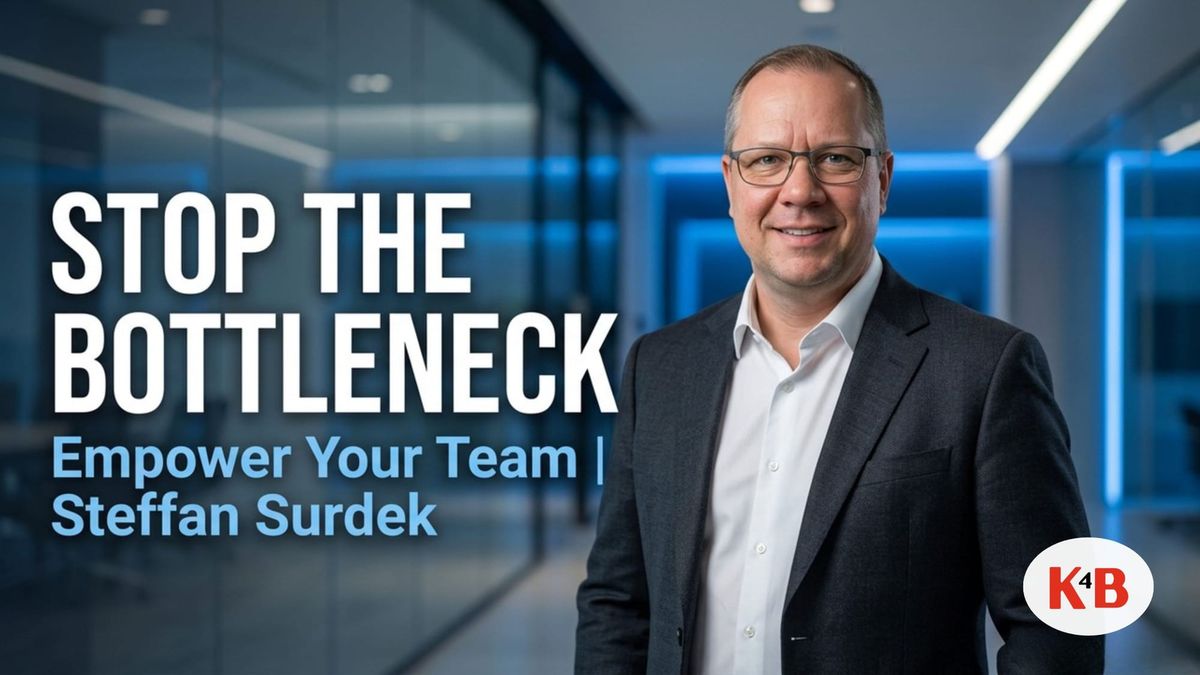
Team Autonomy: How to Stop Being the Bottleneck | Steffan Surdek
Your team isn't waiting because they're lazy. They're waiting because the leader taught them to. Steffan Surdek explains how to change that.

Host: Bernie Franzgrote
Learn how co-creative leadership builds team autonomy, improves delegation, and restores trust — Knack 4 Business with Steffan Surdek. (141 chars) ✅
GROWTH CATEGORY: Leadership & Ops
★ HEADER STRIP
Brought to you by @Hive, Gentry Learning, and Profit10™.

@Hive
At Hive is a networking community for freelancers, growing teams, and anyone who is tired of connection that goes nowhere. In person and online. Real conversations. Real follow-through.
You step out of the room and the work stops. Not because your team is lazy. Because somewhere along the way, they learned to wait for you. Steffan Surdek has spent years helping leaders see that pattern — and break it. In this episode of Knack 4 Business, he walks through exactly how co-creative leadership replaces control with collaboration, one conversation at a time.
Watch the full conversation here:
WHO THIS IS FOR
SMB owners / Team leads / Managers / Corporate escapees building better cultures
KEY LESSONS
1. Your leadership game runs on autopilot — until you look at it
Every leader has an internal operating system Steffan calls their leadership game. It decides how you respond under pressure before you have time to think. Most leaders never examine it. They just react — and their teams learn to work around the reaction instead of with the leader. The fix isn't willpower. It's noticing. Steffan works with leaders for six months or more just on the act of seeing their patterns in real time, without judgment, before trying to change anything.
2. Co-creative leadership starts with one question
Many leaders walk into team meetings with all the answers ready. Steffan flips that. Before offering a solution, ask your team what they see. If they have no ideas, then bring one or two of yours. That sequence — ask first, offer second — changes who owns the problem. A team that generates the solution is a team that executes it. A team that receives the solution is a team that waits for the next one.
3. Trust is built by going first
Patrick Lencioni's work on emotionally-based trust comes down to four questions: is it okay to say I'm sorry, I made a mistake, I don't know, I need help? In most teams, the answer to all four is no — because no leader has modelled it. Steffan's point is direct: someone has to go first. That someone is the leader. When a leader apologies cleanly, without drama, and moves on — the team learns it's safe to do the same. That cascade takes months. It starts in one conversation.
PRACTICAL STEPS
1. Run a post-meeting debrief with yourself
After your next team meeting, take five minutes alone. Ask: what did I notice? When did I shut someone down? When did I take over a problem that wasn't mine to take? Write one thing. That's the noticing practice Steffan uses with every client before anything else changes.
2. Bring a problem to your next meeting — not a solution
Pick one challenge your business is facing. Walk into the meeting and say: here is what we are dealing with — how do you think we should fix this? Then stay quiet. You are not looking for the perfect answer. You are building the habit of your team generating answers. If nothing comes, offer one option and ask what they think of it.
3. Download Steffan's free PDF handbook
Five Key Skills of a Co-Creative Leader — a 10-page distillation of his book with a built-in self-assessment. Read it this week. It shows you where you already lead well and where the gaps are.
ABOUT THE GUEST
Steffan Surdek is a senior leadership advisor and the founder of Surdek Solutions in Montreal. He helps business owners and managers build teams that collaborate, communicate, and make decisions without constant oversight. Drawing on 18 years in software development, he developed the co-creative leadership model — a practical framework for replacing control with contribution. He is the author of The Way of the Co-Creative Leader and posts on leadership three times a week on LinkedIn.
LISTEN ON AUDIO
Listen on Simplecast
Browse all episodes
Partners on this episode
@Hive — Real-world business networking in person and online. Starter membership $99 CAD/year — for freelancers, solopreneurs, and growing teams who want connections that go somewhere.
Gentry Learning — Fred Crouch's real estate education platform. Listings | Investor Club | Free Newsletter
Profit10™ — A structured 10-driver business diagnostic for coaches, consultants, and advisors. See the tool from the client's side first — take the free Snapshot.
FAQ
What is co-creative leadership?
Co-creative leadership is a practical model for replacing top-down control with collaborative decision-making. Instead of arriving with all the answers, the leader creates space for the team to generate solutions — then steps in only when needed. Steffan Surdek has been developing and teaching this approach since 2014.
How long does it take to build a self-sufficient team?
Steffan is consistent on this: six to nine months of deliberate work before a team has enough momentum to sustain itself. One team-building day does not do it. The change happens in weekly meetings, post-meeting debriefs, and small language shifts repeated over time.
How do you rebuild trust after it's been broken?
Steffan points to emotionally-based trust — the kind built when leaders model saying I'm sorry, I don't know, and I need help. Rebuilding starts with one clean admission, no drama attached. The leader goes first. The team follows. It takes longer to rebuild than to build the first time, but the same mechanics apply.
Join Canada Growth Network $47 CDN/m Super CRM tool + Community
Web Indexer webbot quick to install and runs info for you 24/7
Want to be a guest? Register here
Join East Trade Winds — free Tuesdays 8–9 AM EST
K4B ACKNOWLEDGEMENTS
Carl Richards | Fred Crouch | Jovan Strika — @Hive | Melanie Webber