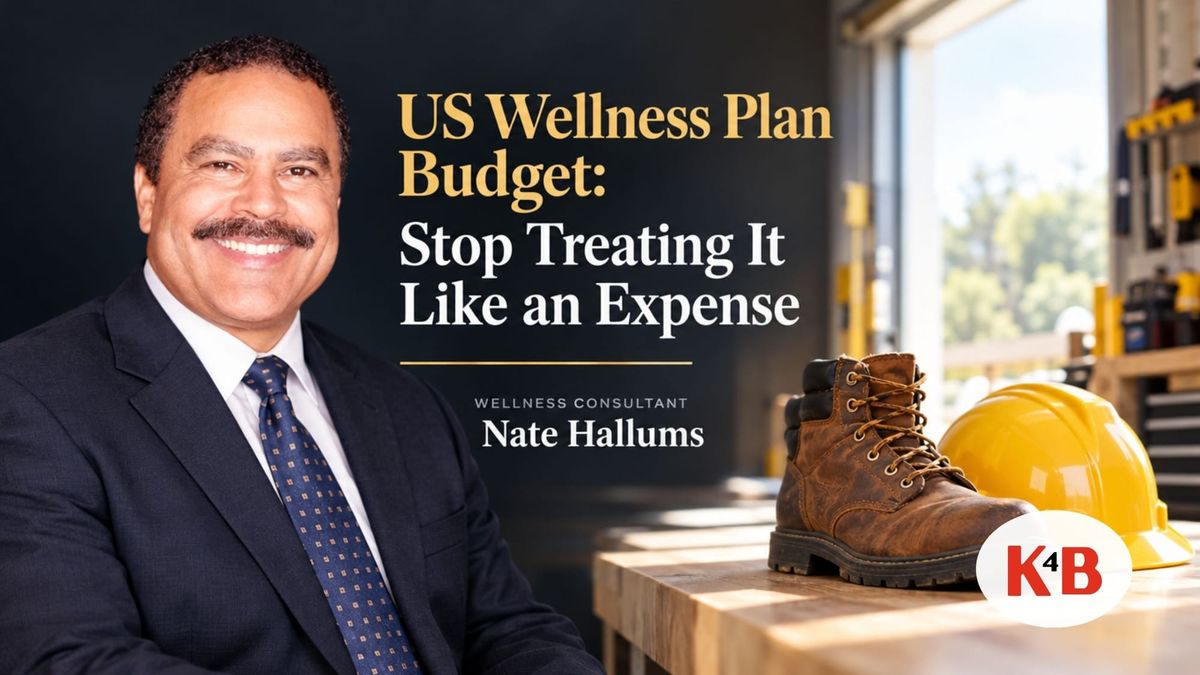
US Wellness Plan Budget: Stop Treating It Like an Expense
Most owners think a wellness plan is a cost. Nate Hallums shows US employers how it can lift participation to 90% and fund growth.

Host: Bernie Franzgrote
Nate Hallums joins Knack 4 Business to show how a US wellness plan cuts benefit costs, lifts participation to 90%, and frees up cash for business growth.
GROWTH CATEGORY: Health & Wellness
Brought to you by Gentry Learning, East Trade Winds, and Notionhive.

You pay for a health plan, and your team still skips the doctor. Maybe the wait is too long. Maybe the deductible is too high. Maybe nobody knows who to call.
Nate Hallums has seen this for nearly 30 years. He started in a Fortune 50 company and now leads BYF Wellness Consulting. He says a wellness plan is not a cost. For US employers, it can be found money.
Nate Hallums is a corporate wellness consultant with nearly 30 years of experience. He helps US employers treat a wellness plan as a smart business investment. In this return visit, he explains how it gives the work force fast access to care, mental health support, and low-cost weight loss drugs at no cost to them. Payroll tax savings can then go back into the business to fuel growth.
Watch the full conversation here:
Many US employers offer a wellness plan that few staff use. Nate Hallums, a corporate wellness consultant with nearly 30 years of experience, explains how a plan that sits on top of health insurance can lift participation to 90 percent. Employers can also redirect payroll tax savings into growth.
Who this is for
US small business owners, consultants, fractional executives, and leaders building systems.
Key lessons
1. Access is the gap, not coverage.
Most people have insurance but still cannot get care fast. Nate tells how one knee shot took two referrals and weeks of waiting. His plans cut that to days. For a tick bite, an urgent care hotline gave a same-day answer.
2. Participation is the number that matters.
Most wellness plans reach about 20 percent of staff. A bank manager told Nate he paid people to join and still got 32 percent. Nate's plans reach 90 percent because people feel looked after, with one person to call.
3. The savings can fund growth.
The plan redirects FICA, the payroll tax for Social Security and Medicare. Nate says the employee benefits bank is about $300 a month, and the plan costs about half. Employers can save about $1,000 a year, and some states cut workers' comp by 20 to 30 percent. There is no rule on how you spend it.
Practical steps
- Ask how many of your staff used the plan you pay for last year.
- Check that you have health insurance in place and pay FICA. The plan sits on top of both.
- If you advise businesses, ask whether a wellness plan could be part of your next bid.
About the guest
Connect with Nate: LinkedIn · SIMERP · Book time
Listen on audio
Partners on this episode
Gentry Learning: real estate education, listings, and an Investor Club from Fred Crouch.
East Trade Winds: free weekly networking, community first.
Notionhive: websites built to bring in leads and clients.
FAQ
Does a wellness plan replace health insurance?
No. It sits on top of your insurance. Nate says it cannot be the first line of defense, but it can be the first point of access.
Can a small business use it?
Yes. Nate says it works the same for 15 staff or 1,000. You need health insurance in place, and you must pay FICA.
Does it work outside the US?
No. It applies to US employers and US territories where FICA is paid.
- Join Canada Growth Network: $47 CDN, a robust CRM plus community
- Web Indexer: quick install chatbot, info 24/7 for visitors. Install it today
- Browse all episodes (K4B / ETW / CGN)
- Search K4B episodes by topic. This uses that Web Indexer!
- Want to be a guest? Register here
K4B acknowledgements
- Carl Richards
- Fred Crouch
- Jovan Strika, @Hive
- Melanie Webber
- Thank you to Dave McFarland of FocusOPEX for the introduction.