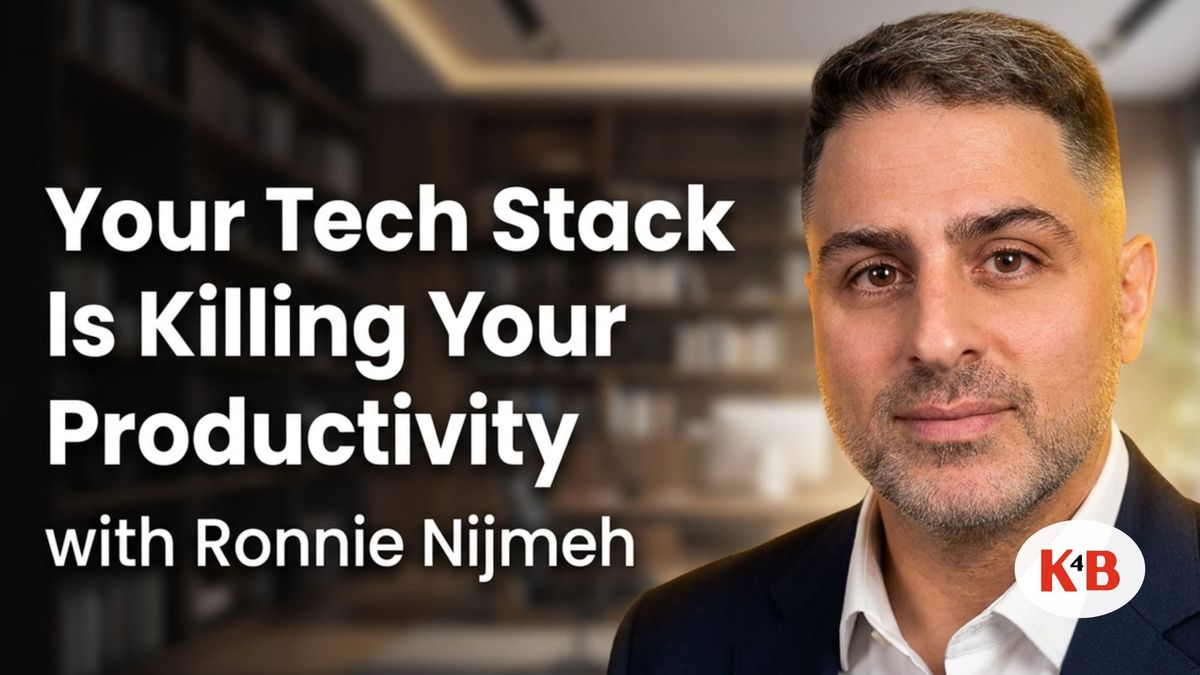
Your Tech Stack Is Killing Your Productivity | Ronnie Nijmeh
Ronnie Nijmeh replaced a team of 20 with AI. Here's the Skills framework, second brain system, and tech stack approach he uses, and how solo operators can build it too.

Host: Bernie Franzgrote
Solo operator Ronnie Nijmeh replaced a team of 20 with AI. Learn his Skills framework, second brain system, and tech stack shortcuts.
GROWTH CATEGORY: AI & Automation
Brought to you by Canada Growth Network, WebIndexer, and Profit10™.

A business community with a full CRM stack built in. Real connections, real tools, $47 CAD/month.
If your to-do list runs longer than your day, the problem probably isn't your effort. It's your setup. Ronnie Nijmeh figured that out after 18 years of running a SaaS company with 650,000 customers, a team of 20, and $14M in sales. He sold it, took a year off with his family, and rebuilt from scratch — solo. No agency, no video editor, no stack of subscriptions. Just Claude and Chrome. Now he teaches other solo owners how to do the same.
Watch the full conversation here:
WHO THIS IS FOR
Solopreneurs / Coaches and consultants / SMB owners / Anyone running their business on willpower and too many tools
Key Lessons
1. You're not the bottleneck. Your system is.
Most solo operators think they need to work harder or hire someone. Ronnie's take is different. The move is to become the orchestrator — the person who directs the system instead of doing every job inside it. Your years of business experience aren't a backup plan. They're the secret weapon. AI can build. You decide what gets built, what's right, and what needs fixing. That's the role no one else can fill.
2. Skills are the missing piece between a prompt and a process.
A skill is more than a prompt. It's a structured instruction set — sometimes including scripts and agents — that walks AI through a complete multi-step task. Ronnie's blog post skill checks Google Search Console, finds trending keywords, writes the article, creates illustrations, and publishes — all automatically. A weekly newsletter that used to take three to four days now takes one hour. The skill does the repeatable work. You do the judgment call at the end.
3. Your second brain makes everything smarter over time.
Feed AI everything about your business — bios, transcripts, emails, past decisions, presentations. Store it in Obsidian, a free portable tool that keeps your knowledge in plain text files. Every session gets logged. Every output improves. And because it's not tied to any single platform, you can switch AI tools without starting over. The brain moves with you.
Practical Steps
1. Write down every task you repeat this week.
Take a clipboard to a coffee shop — Ronnie actually says this — and list everything you do on a daily, weekly, or monthly basis. That list is your automation roadmap. Start with the task that costs you the most time.
2. Build your second brain before anything else.
Download Obsidian. Create a raw folder. Start loading it with everything about your business — your bio, your offers, past emails, transcripts, decisions. The more it knows about you, the better every output gets from day one.
3. Start with a simple model, not the top tier.
You don't need Claude Max to summarize an email. Save the high-tier tools for strategy, builds, and complex processes. Use simpler models for simple tasks. You'll stretch your tokens further and get more done inside your plan.
About the Guest
Ronnie Nijmeh is the founder of The Solo Creators — a community and skills platform for solo business owners who want to use AI to work faster, create better content, and grow without adding staff. He spent 18 years running a SaaS company that served 650,000 customers before selling it and going solo. Now he helps coaches, consultants, and solo operators build the AI systems that let them operate like a team of one — with the output of ten. Find him on LinkedIn, YouTube, and Instagram.
Listen on Audio
Listen on Simplecast
Browse all episodes
Partners on this episode
Canada Growth Network — A business community with a full CRM stack built in. Real connections, real tools, $47 CAD/month.
WebIndexer — Turn your website into a 24/7 client assistant. See it live on knack4business.com.
Profit10™ — Take the free Profit Snapshot. Ten questions. Find out what's really holding your business back.
FAQ
Q: Do I need to know how to code to use AI the way Ronnie does?
No. Ronnie's client in his 60s deployed a live website through Claude with zero coding background. The Skills framework handles the technical steps. You provide the direction.
Q: What's the difference between a prompt and a skill?
A prompt is a one-time question. A skill is a structured, repeatable system — sometimes including scripts and agents — that walks AI through a complete multi-step process the same way every time.
Q: Is it risky to run your business almost entirely on one AI platform?
Ronnie addresses this directly. Because the second brain lives in plain text files on your local computer, you're never locked in. Switch platforms anytime — your knowledge and history come with you.
- Join Canada Growth Network — $47 CDN — a robust CRM + community
- WebIndexer — Quick install chatbot. Info 24/7 for visitors
- Browse all episodes (K4B / ETW / CGN)
- Search K4B episodes by topic - uses the Web Indexer!
- Want to be a guest? Register here
- Ronnie's free Website Audit Playbook