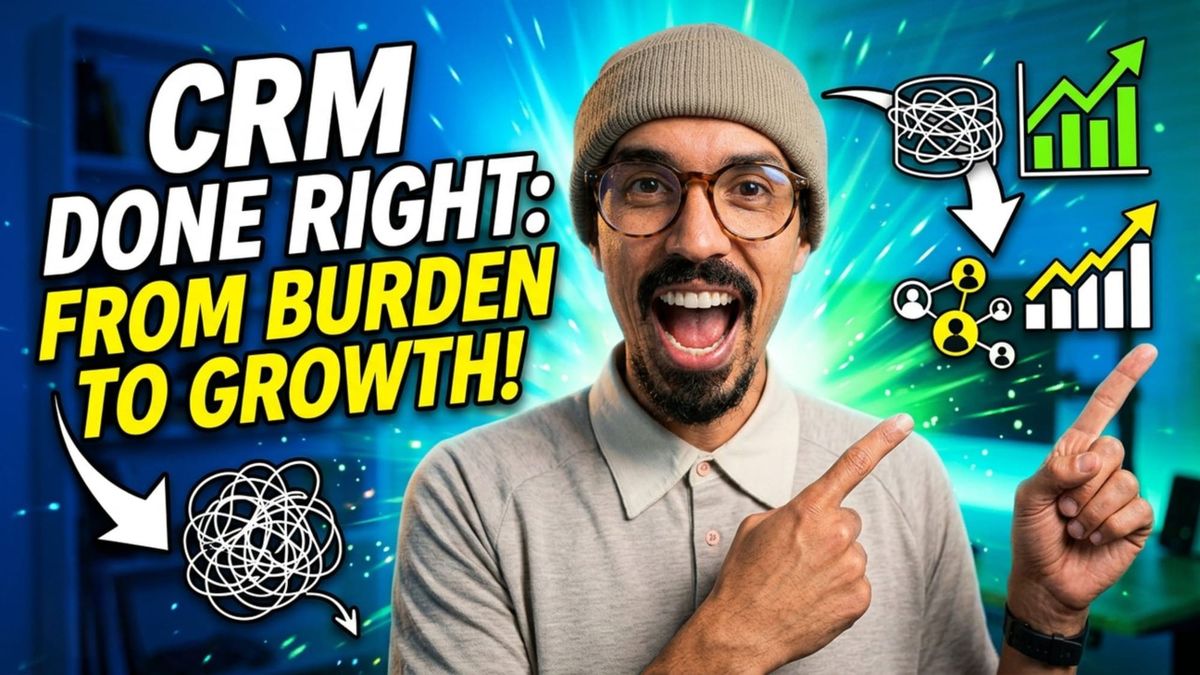
CRM done right looks more like this | Brandon Drake
Brandon Drake — the Healthy Data Guy — joins Knack 4 Business to break down why most CRMs fail small businesses and how to fix yours with clean data, smart automation, and a relationship-first strategy.

Hosts: Bernie Franzgrote and Wayne Pratt
Brandon Drake — the Healthy Data Guy — shows SMBs how to turn a broken CRM into a relationship-driven growth engine. Listen on Knack 4 Business. (148 chars)
GROWTH CATEGORY: AI & Automation
Most business owners have a CRM. Most of them aren't using it right. The data is messy, the follow-up is inconsistent, and the tool that was supposed to save time is just another thing to manage. Brandon Drake — the Healthy Data Guy — helps businesses fix that. He joined Bernie Franzgrote on Knack 4 Business to share what a healthy CRM actually looks like.
Watch the full conversation here:
WHO THIS IS FOR
SMB owners / Solopreneurs / Corporate escapees / Leaders building systems
If your CRM feels more like a digital junk drawer than a business tool — this episode is for you.
Key Lessons
1. The right data beats more data.
Most businesses collect whatever they can and hope something useful comes out of it. Brandon's approach is the opposite. He asks targeted questions before he builds anything — because the quality of your CRM output depends entirely on the quality of what goes in. He stores those answers so they can be searched, filtered, and turned into action. One good question asked consistently is worth more than a hundred fields nobody checks.
2. Engagement scoring tells you who's ready — before they tell you.
Brandon uses engagement scoring to track every interaction a contact has with his content. Email opens, replies, form submissions, calendar bookings — each one adds points. Unsubscribes remove them. A contact with a score over 100 is highly engaged. That's your warmest lead. That's your most likely referral partner. You don't have to guess or rely on gut feel. The system shows you — if you set it up to look.
3. AI is the cherry on top. Not the foundation.
This is the one Brandon comes back to more than once. Business owners want to jump straight to AI because it sounds like the shortcut. It isn't. If your data is messy and your strategy is unclear, AI just scales the problem. Get your foundation solid first — strategy, data hygiene, core automations — and then layer in AI where it actually helps. Voice AI for inbound calls. Conversational AI on your website. In that order.
Practical Steps
- Audit your CRM this week. Open it and ask one question: does this tell me who I should follow up with today? If the answer is no, you have a strategy problem, not a software problem.
- Set up engagement scoring. If your CRM supports it, turn it on. Assign points to email opens, replies, and bookings. Check your top 10 contacts by score. That list should surprise you.
- Build one automated follow-up sequence. Start simple. New contact enters your CRM → email at 28 days → email at 90 days. Warm, personal tone. Calendar link included. Run it for 90 days and see what books.
About the Guest
Brandon Drake is the Healthy Data Guy — a CRM consultant who helps service-based small and medium-sized businesses clean up, organize, and optimize their CRM data. His background spans data migration, culinary arts, and functional nutrition — a combination that shaped a consulting approach built entirely around understanding the client before building the solution.
He works with businesses that are already relationship-driven. If you're transactional by nature, he'll refer you elsewhere. That clarity is part of what makes him effective.
Find Brandon at healthydataguy.com or connect on LinkedIn. Download his free CRM Selection Guide.
Listen on Audio
Listen on Simplecast
Browse all K4B episodes
FAQ
Q: How do I know if my CRM is actually working? Ask yourself one question: does it tell you who to follow up with today? If you're not sure, your CRM isn't working as a strategy tool. It's working as a storage tool — and those aren't the same thing.
Q: What should I look for when choosing a CRM for my small business? Brandon's four criteria: avoid stair-step pricing, align with the founders' values, test the software yourself, and confirm that real human support is available. A CRM that charges you more as you grow will become a problem faster than you expect.
Q: When should I add AI to my CRM? After your foundation is solid. That means clean data, a clear follow-up strategy, and at least one working automation sequence. Once those are running smoothly, voice AI and conversational AI become genuine upgrades. Before that, they're distractions.
K4B Acknowledgements
Carl Richards
Fred Crouch
Jovan Strika — @Hive
Melanie Webber