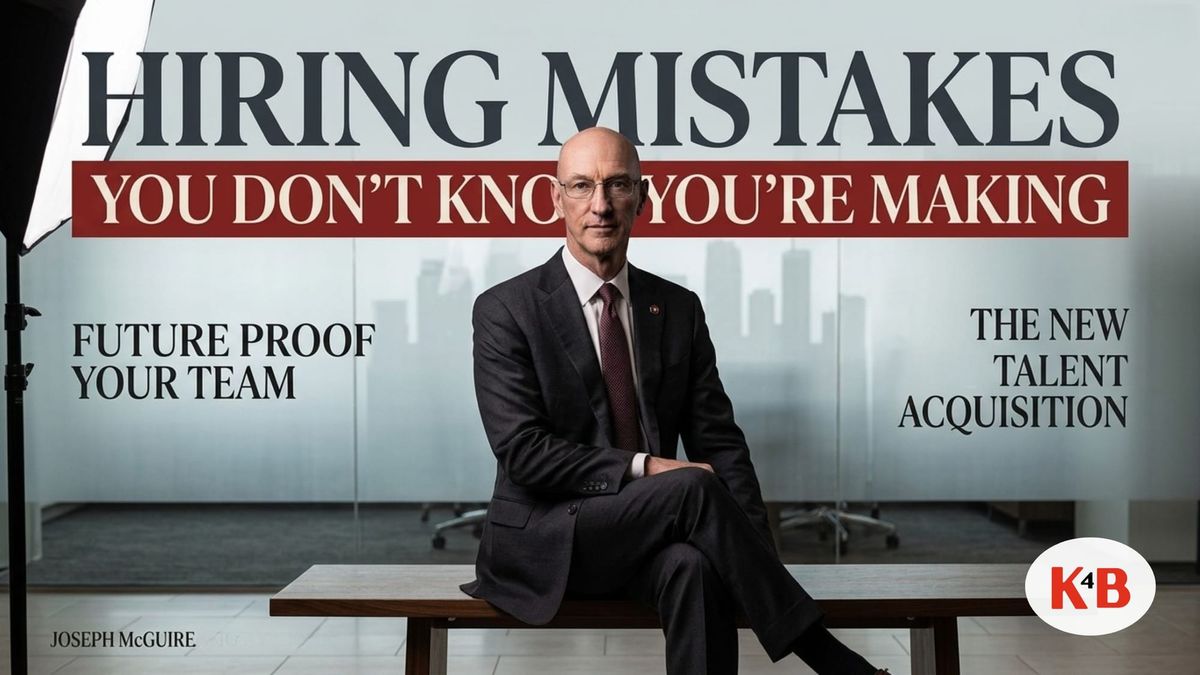
Hiring Mistakes You Don't Know You're Making | Joseph McGuire
Joseph McGuire teaches leaders to read body language, decode facial cues, and negotiate with clarity. This episode covers how to stop making costly hiring mistakes, before they happen.

Host: Bernie Frangrote
Body language expert Joseph McGuire reveals how face reading and behavioral negotiation stop costly hiring mistakes.
GROWTH CATEGORY: Leadership & Ops
Brought to you by Canada Growth Network, Gentry Learning, and Profit10™.

A business community where SMBs and solopreneurs get real connections and a full CRM stack. $1 CAD first month, $47/month.
Joseph McGuire can name it. He's the founder of ClearSight Communications and a specialist in body language, face reading, and behavioral negotiation. He's been helping leaders see past the polished surface for over 30 years.
This episode is about the gap between what you see and what's actually there.
Watch the full conversation here:
WHO THIS IS FOR
SMB owners / Solopreneurs / Corporate escapees / Leaders building systems
Key Lessons
1. Gut instinct is a trainable skill.
Most people have been conditioned to second-guess themselves. Joseph says everyone has a memory of a time their gut was right and they ignored it. That memory is where the retraining starts. Once you reconnect with that signal — and pay attention to what you put in your gut — the accuracy returns. Then it's just practice.
2. Silence is a precision tool.
The best interviewers don't fill the gap. They wait. When Joseph asks a hard question in a C-suite panel, the whole room goes quiet. What the candidate says next — unprompted — is usually the most honest thing they say. If they give you the exact same answer in the exact same words the second time, that answer was prepared.
3. Every deal is personal.
The Camp David negotiations were collapsing. Begin was leaving. Carter didn't send a lawyer. He got photos of Begin's grandchildren, wrote their names above each one, and went to see him alone. Begin became emotional and came back to the table. That's behavioral negotiation at its highest level. The personal moment did what the proposals couldn't.
Practical Steps
- Watch a politician being interviewed. Play it once with sound on. Rewind. Watch with sound off. Ask: is what you're seeing congruent with what you heard? Do this once a week. Free training, zero cost.
- Use silence in your next interview or negotiation. Ask your hardest question. Then stop talking. Count to ten if you need to. What fills that gap is real data.
- Get clear on your BATNA before any big conversation. Know your best alternative to a deal and your worst. That clarity changes how you read the room — and how you move inside it.
About the Guest
Joseph McGuire helps leaders and organizations decode hidden intent, improve C-suite hiring outcomes, and navigate high-stakes negotiations — globally. His background spans ancient Chinese face reading (miancheng), over 30 years in holistic therapy, and deep experience in corporate interviewing and behavioral negotiation. He works with executives and teams across North America, the Middle East, and beyond.
Connect with Joseph on LinkedIn | ClearSight Communications
Listen on Audio
Listen on Simplecast
Browse all episodes
Partners on this episode
Canada Growth Network — A business community where SMBs and solopreneurs get real connections and a full CRM stack. $1 CAD first month, $47/month.
Gentry Learning — Real estate education that builds real wealth, with Fred Crouch. Courses, active listings, Investor Club, and a free newsletter.
Profit10™ — Take the free Profit Snapshot. Ten questions. A clear read on what's holding your business back.
FAQ
What is face reading and can it actually be learned?
Face reading — miancheng in ancient Chinese practice — is the study of how static and dynamic facial features reveal personality traits, stress responses, and communication style. Joseph has been teaching it for over 30 years. Yes, it can be learned. The foundations are accessible to anyone willing to slow down and pay attention.
How do you know if someone is being deceptive versus just nervous?
The signals are often similar — a spike in blink rate, jaw tension, voice tightening. But deception isn't the only explanation. Joseph's approach is to notice the hotspot, let the conversation flow, then come back to it. What happens the second time tells you more than the first.
Is this relevant for small business owners or just large corporations?
Both. The same principles that help a Fortune 500 panel avoid a bad C-suite hire help an SMB owner evaluate a potential partner, contractor, or investor. The stakes differ. The signals don't.
- Join Canada Growth Network — $47 CDN/month. A robust CRM + real community.
- Web Indexer — Quick install chatbot. Info 24/7 for your visitors.
- Search K4B episodes by topic
- Want to be a guest? Register here