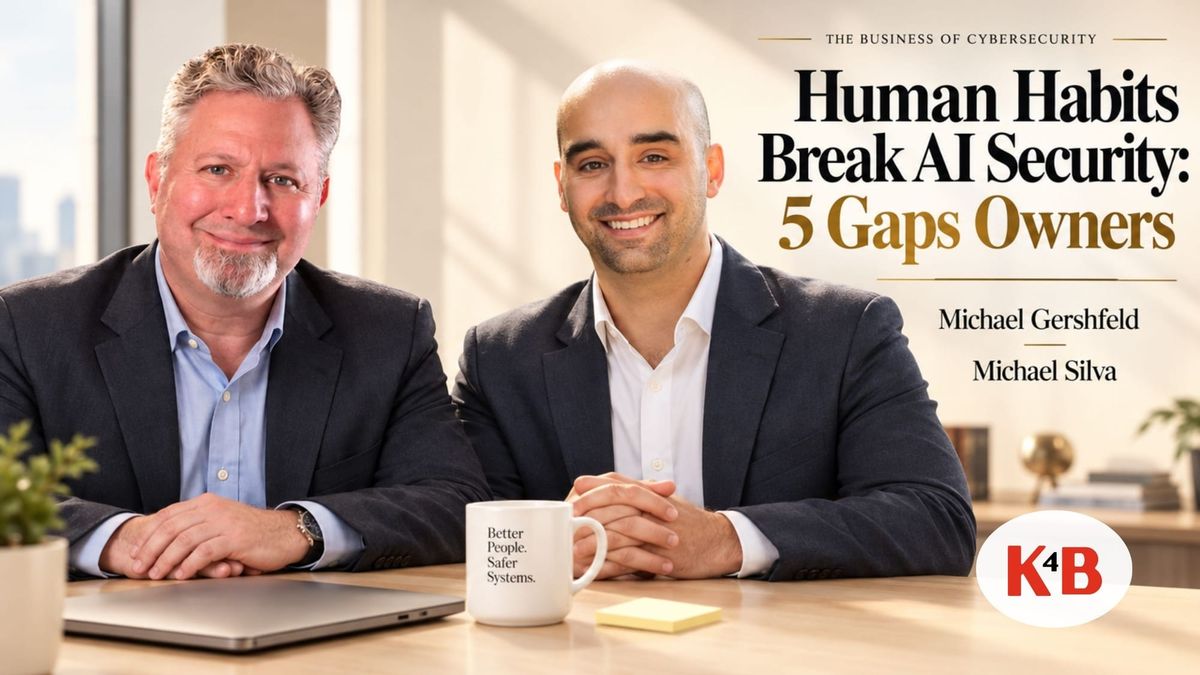
Human Habits Break AI Security: 5 Gaps Owners
Most AI data leaks start with people, not software. Michael Silva and Gersh of Emely AI name five security gaps owners miss.

Host: Bernie Franzgrote
Learn the five AI security gaps owners miss, from shadow IT to weak multi-factor setups. Michael Silva and Gersh of Emely AI explain on Knack 4 Business.
GROWTH CATEGORY: Cybersecurity & IT
Brought to you by East Trade Winds, Profit10, and Gentry Learning.

Your team is already using AI tools. Do you know where your client data goes when they hit send?
Most owners are asking the wrong question. They ask if AI can help. The better question is what happens to the data. Michael Gershfeld and Michael Silva of Emely AI have spent two and a half years building private AI for companies. They say the tech is only half the story.
Michael Gershfeld and Michael Silva of Emely AI explain data privacy in plain words. Gershfeld, known as Gersh, brings 30 years in tech sales. Silva has 25 years in IT and cybersecurity and runs ArchonOne. They show how a private AI setup keeps company data inside its own walls. They share real court cases on AI and data privacy. Their cyber awareness message is simple: tools help, but human habits decide whether data stays safe.
Watch the full conversation here:
Most AI data leaks start with people, not software. Michael Silva, CEO and CISO of Emely AI and founder of ArchonOne, and Michael Gershfeld explain how private AI keeps company data inside its own walls. Owners will learn five security gaps to check this week, from shadow IT to forgotten service accounts.
Who this is for
SMB owners, solopreneurs, and leaders building systems who want AI without a data leak.
Key Lessons
1. Security is a habits problem. Silva said human behavior has not changed in generations. Only the tools have. His example: how often do you really lock the deadbolt? If it is not every time, you have accepted a lower standard.
2. Public AI chats are not private. Silva described a court order in the New York Times case against OpenAI that forced chat logs to be disclosed. Only customers with zero data retention were left out. He also pointed to a New York ruling that documents made with a consumer AI tool were not privileged. He warned that sharing privileged material with an outside AI platform could waive privilege on the original conversation.
3. Five gaps hide in plain sight. Silva named identity sprawl, shadow IT, the multi-factor gap, service accounts and API keys, and the supply chain blind spot. Ex-employees often keep access to apps like Figma, Notion, and ChatGPT. Staff paste client files into tools nobody approved. A forgotten service account with admin rights can be the way in.
Practical Steps
- List every tool your team uses, including AI tools, and remove access for anyone who left.
- Write an AI rule people can follow, then give them an approved tool. Silva said the official policy is often a Word document nobody reads.
- Turn on multi-factor now. Then ask your IT partner about passwordless and device-based sign-in. Change every default password, and review old service accounts and API keys.
About the guests
Michael Silva is CEO and CISO of Emely AI and founder of ArchonOne. Connect: Michael Silva on LinkedIn · Michael Gershfeld on LinkedIn · Emely AI on LinkedIn
Listen on audio
Partners on this episode
- East Trade Winds — free weekly networking, community first.
- Profit10 — a free ten-question Profit Snapshot.
- Gentry Learning — Fred Crouch's real estate courses, listings, and Investor Club.
FAQ
Is a private AI setup really safer than a public one?
Often yes. In a private setup, your data stays in your own environment and the AI only looks at your approved files. Gersh said most of the time only a log is kept, with no question or answer stored.
Is multi-factor sign-in enough?
No. Silva said turn it on if you have nothing, but it is not the end state. A stolen phone number can defeat text-message codes. Passwordless sign-in is the better goal.
What is shadow IT?
It is any tool your team uses without approval. Today that often means pasting client documents into AI tools with no contract, no data agreement, and no audit log.
- Join Canada Growth Network — $47 CDN, a robust CRM + Community
- Web Indexer — Quick install chatbot. Info 24/7 for visitors. Install it today.
- Browse all episodes (K4B / ETW / CGN)
- Search K4B episodes by topic — this uses that Web Indexer!
- Want to be a guest? Register here
K4B Acknowledgements
Carl Richards · Fred Crouch · Jovan Strika — @Hive · Melanie Webber
Thank you to Lisa Snow for the introduction.