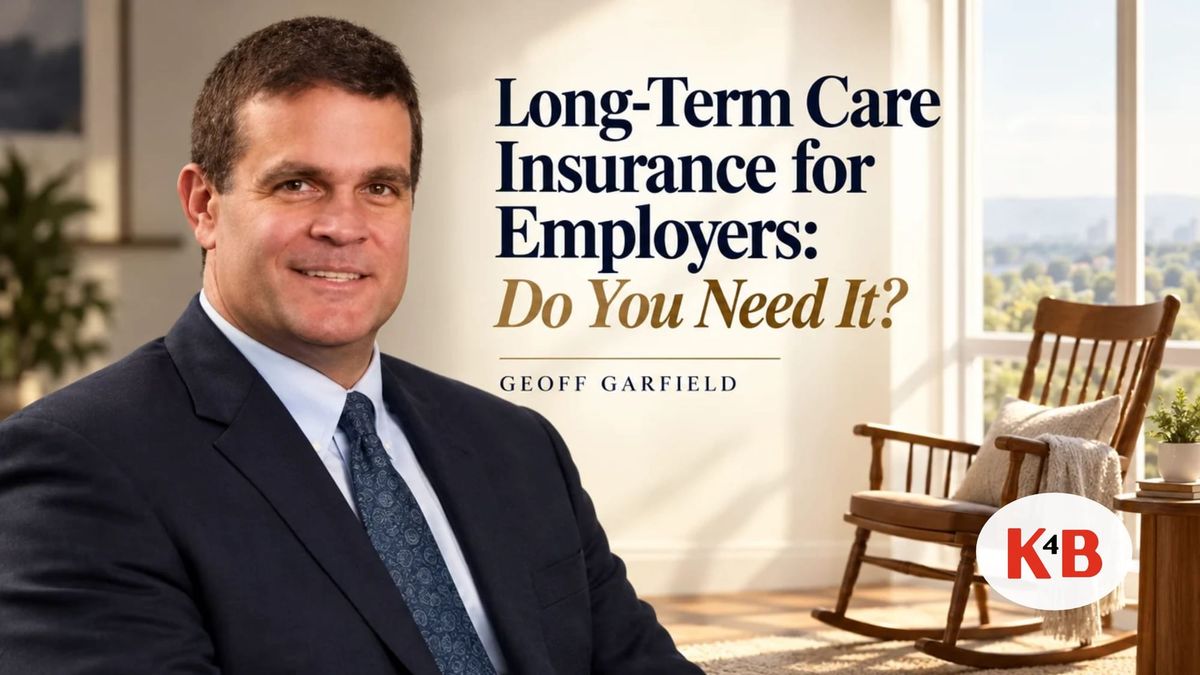
Long-Term Care Insurance for Employers: Do You Need It?
Geoff Garfield of ACSIA Partners explains how group long-term care insurance protects employees and their families ~ no medical underwriting required. Learn what triggers coverage and how to start planning early.

Host: Bernie Franzgrote
Geoff Garfield of ACSIA Partners breaks down group long-term care insurance for employers ~ guaranteed issue, no underwriting, real protection for your team.
GROWTH CATEGORY: Real Estate & Wealth Building
Brought to you by Gentry Learning.

Fred Crouch’s real estate education hub, with courses, listings, and an Investor Club for anyone building long-term wealth.
Most business owners think their health insurance already covers this. It doesn’t. And when a parent ~ or an employee ~ needs long-term care, the bill can wipe out savings fast. Geoff Garfield learned that the hard way, and now he helps companies close that gap before it becomes a crisis.
Geoff Garfield spent nearly 30 years on Wall Street before his own parents needed long term care with no plan in place. That gap led him into insurance, where he now works with ACSIA Partners, the largest independent long term care insurance brokerage in the US. Geoff helps HR teams, benefit brokers, and business owners set up group coverage for companies with 30 or more employees ~ guaranteed issue, no medical underwriting, flexible payment options. He explains how health care costs climb as people age, what triggers a payout, and how families lean on home care and other support without draining their savings.
Watch the full conversation here:
Most business owners assume their insurance already covers long-term care. It doesn’t. Geoff Garfield of ACSIA Partners explains how group long-term care coverage protects employees and their families without medical underwriting. This conversation covers exactly what triggers coverage and how to start planning before a crisis hits.
WHO THIS IS FOR
SMB owners / Solopreneurs / Corporate escapees / Leaders building systems
KEY LESSONS
Guaranteed issue opens the door for people who’d otherwise be turned down. Any business owner or employee with a health issue ~ even something from years ago ~ can often still qualify through a group plan of 30+ people. Example: someone who had a heart attack a decade ago might be denied an individual policy but accepted through their own company’s group plan.
Coverage isn’t about age ~ it’s about ability. The trigger is losing 2 of 6 daily activities, or a doctor confirming cognitive decline, and that can happen at any age through illness, accident, or early-onset conditions. Example: a car accident can trigger benefits just as easily as aging does.
The money comes with no strings attached. Most policies pay out in cash each month ~ no receipts, no pre-approval. Example: Geoff’s own family used extra income to hire additional therapists beyond what their facility provided.
PRACTICAL STEPS
- If your company has 30+ employees, ask your benefits broker about guaranteed issue long-term care coverage ~ no medical questions required.
- Decide how to structure payment: fully employer-paid, fully voluntary, or a mix by role.
- Start small if you need to. Even $15 a paycheck can build toward a real benefit over time.
ABOUT THE GUEST
Geoff Garfield is the long-term care specialist at ACSIA Partners ~ the largest independent long-term care insurance brokerage in the US. Connect: LinkedIn.
LISTEN ON AUDIO
Listen on Simplecast
Browse all episodes
PARTNER ON THIS EPISODE
Gentry Learning ~ Fred Crouch’s real estate education hub, with courses, listings, and an Investor Club for anyone building long-term wealth.
FAQ
What triggers a long-term care insurance payout?
Coverage starts once you can’t perform 2 of 6 daily activities ~ bathing, dressing, eating, transferring, toileting, or continence ~ or a doctor confirms cognitive decline. It isn’t tied to age.
What does guaranteed issue coverage mean?
For companies with 30 or more employees, insurers often skip medical underwriting entirely. Pre-existing conditions don’t disqualify you, because the risk spreads across the whole group.
Does coverage stay with an employee who leaves the company?
Yes. US law requires portability, so employees keep their coverage and group rate even if they retire or change jobs.
- Join Canada Growth Network ~ $47 CDN a robust CRM + Community
- Web Indexer ~ Quick install chatbot, info 24/7 for visitors
- Search K4B episodes by topic
- Want to be a guest? Register here
K4B ACKNOWLEDGEMENTS
- Carl Richards
- Fred Crouch
- Jovan Strika ~ @Hive
- Melanie Webber
- Special thanks to Lisa Snow ~ founder of On The Mend Wellness ~ the introduction that made this episode happen.