Real Estate Development vs Selling: Why Holding Land Wins in 2026
Most landowners sell too early ~ and hand the profit to the developer who already knew what the land was worth. Eugene Gershman explains what to do instead.

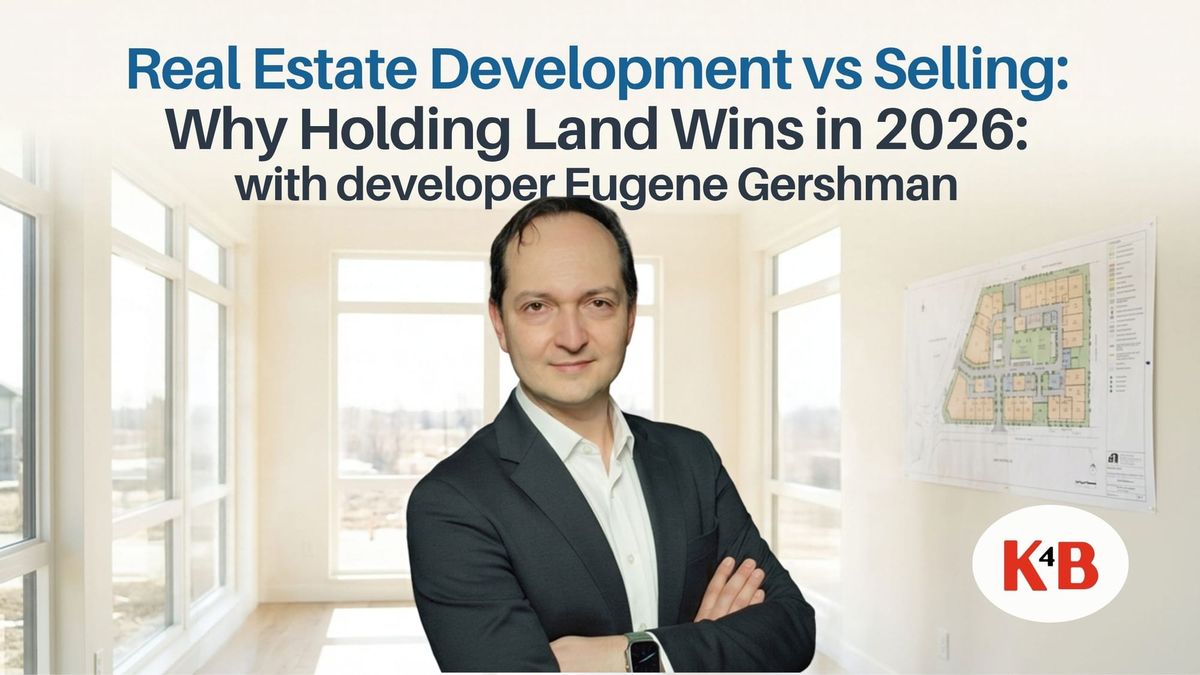
Host: Bernie Franzgrote
Eugene Gershman of GIS Companies explains how landowners can develop instead of sell ~ feasibility, capital stack, and investment metrics unpacked.
GROWTH CATEGORY: Real Estate & Wealth Building
Brought to you by Web Indexer, Profit10™, and Wise.

Turns your website into a 24/7 client-facing sales assistant. See it live on knack4business.com.
You own a piece of land. Developers keep calling. The offers keep coming. And every time, the easiest move feels like selling.
But the developer making the offer already knows what the land is worth — developed. That's the gap Eugene Gershman has spent his career closing.
Eugene is the CEO of GIS Companies, a Pacific Northwest-based firm built for retail landowners — the family sitting on 10 acres for 30 years, the investor who inherited a property, the business owner building wealth outside the company. He steps in as the owner's development team, running everything from feasibility study through permitting, contractor selection, debt financing, and exit. His fee covers operations only. The real return comes when the project succeeds.
This episode covers what most landowners and investors never learn — how to run a feasibility study, how a capital stack actually works, what investment metrics like equity multiple really mean, and why the lowest contractor bid is almost always the most expensive decision you'll make.
Watch the full conversation here:
Real estate development is one of the oldest professions in the world. But most retail landowners have never been invited into the room where it happens. Eugene Gershman wants to change that. He works only with owners ~ not institutional buyers ~ and structures his company so that the only way GIS makes real money is if the project succeeds. Ten questions. A clear path. A partner who loses if you lose.
WHO THIS IS FOR
Landowners sitting on undeveloped property. Passive investors exploring real estate development for the first time. Family offices looking at build-to-hold strategies. Solopreneurs and SMB owners building long-term wealth outside their business.
Key Lessons
1. A feasibility study is the first decision ~ not a formality
Before Eugene engages on any project, his team runs a pre-feasibility review. Code research, topography, utilities, construction cost estimates, and a pre-application meeting with the municipality. The output is a detailed pro forma and an honest answer: does this pencil or not? Many owners come in with assumptions. The feasibility study either confirms them or saves them from an expensive mistake. Eugene published a free version of the framework his team uses internally ~ the same checklist, step by step. If you own land, start there. Download it here.
2. The capital stack tells you exactly where you stand
A capital stack is the full pile of money that funds a development project ~ typically 20–30% equity and 70–80% debt. Equity splits into general partners and limited partners. GPs take on more risk and more upside. LPs come in later when the variables are reduced ~ permits in hand, financing arranged, hard bids from contractors ~ and take a steadier return in exchange for less exposure. Knowing where you sit in the stack tells you how much you can make, how much you can lose, and what happens if the project has to be liquidated. High leverage amplifies both directions. That's the conversation most landowners never have before they borrow.
3. Equity multiple is the only metric worth watching
Eugene targets a 20% profit margin on total cost versus total revenue, and a 2x equity multiple for every investor in the deal. He has little use for IRR ~ internal rate of return ~ because it shifts based on whatever time horizon you plug in. The same project can show dramatically different IRR numbers just by changing the projection from 10 years to 7. Equity multiple is harder to manipulate. You put in a dollar. The target is to get two dollars back. If it doesn't hit that benchmark, the project doesn't move forward.
Practical Steps
1. Run the feasibility checklist before any other conversation
Download Eugene's free framework at giscompanies.co/feasibility-study and run your own pre-feasibility pass. It won't replace professional analysis, but it will tell you whether the conversation is worth having ~ before you pay anyone to have it.
2. Map your capital stack before you talk to lenders
Know your equity position ~ what the land is worth, what additional cash you can contribute, and what return you need to make the project worth the risk. Then work backward from there to understand what debt structure makes sense. Going into a lender conversation without this picture is how owners end up over-leveraged.
3. Get a contractor at the table before you hire an architect
Most people think you design the building and then bid it out. Eugene says this is backwards. You need someone who has built similar projects in the last five years, can open their records and tell you what it cost, and is willing to show you every invoice. Get that person in the room before a single drawing is made. It changes the whole conversation.
About the Guest
Eugene Gershman is the founder of GIS Companies ~ a Pacific Northwest real estate development firm that works exclusively on the owner's side of the table.
Connect: LinkedIn · Instagram · Facebook · Podcast
Listen on Audio
Listen on Simplecast
Browse all episodes
Partners on this episode
Web Indexer ~ Turns your website into a 24/7 client-facing sales assistant. See it live on knack4business.com.
Profit10™ ~ Free Profit Snapshot: ten questions that show you where your business is strong and where it's leaking.
Wise ~ Send and receive money across borders without the bank fees.
FAQ
What is an owner-side developer?
An owner-side developer works exclusively for the landowner ~ not the buyer or the institution. They run the full development process (feasibility, permitting, contractor management, capital raising, and exit) and only profit when the project succeeds. Eugene's fee covers operations. The real return comes from a small equity share in the finished project.
What does a feasibility study actually include?
A thorough feasibility study covers zoning and code research, topography and wetlands review, utility availability, construction cost analysis in the local market, absorption research (rental or sale comparables), and a pre-application meeting with the municipality. The final output is a detailed pro forma ~ what the project will cost, what it will return, and what the exit looks like.
What is a capital stack in real estate development?
A capital stack is the full structure of funding for a development project. It typically includes 70–80% debt (senior lender plus sometimes mezzanine) and 20–30% equity. Equity divides into general partners (GPs) ~ who carry more risk and more upside ~ and limited partners (LPs), who invest later in the process when risk is lower and returns are steadier.
- Join Canada Growth Network ~ $47 CDN/month. A robust CRM + community.
- Web Indexer ~ Quick install chatbot. Info 24/7 for visitors ~ install it today.
- Browse all episodes ~ K4B / ETW / CGN
- Search K4B episodes by topic ~ this uses that Web Indexer!
- Want to be a guest? Register here