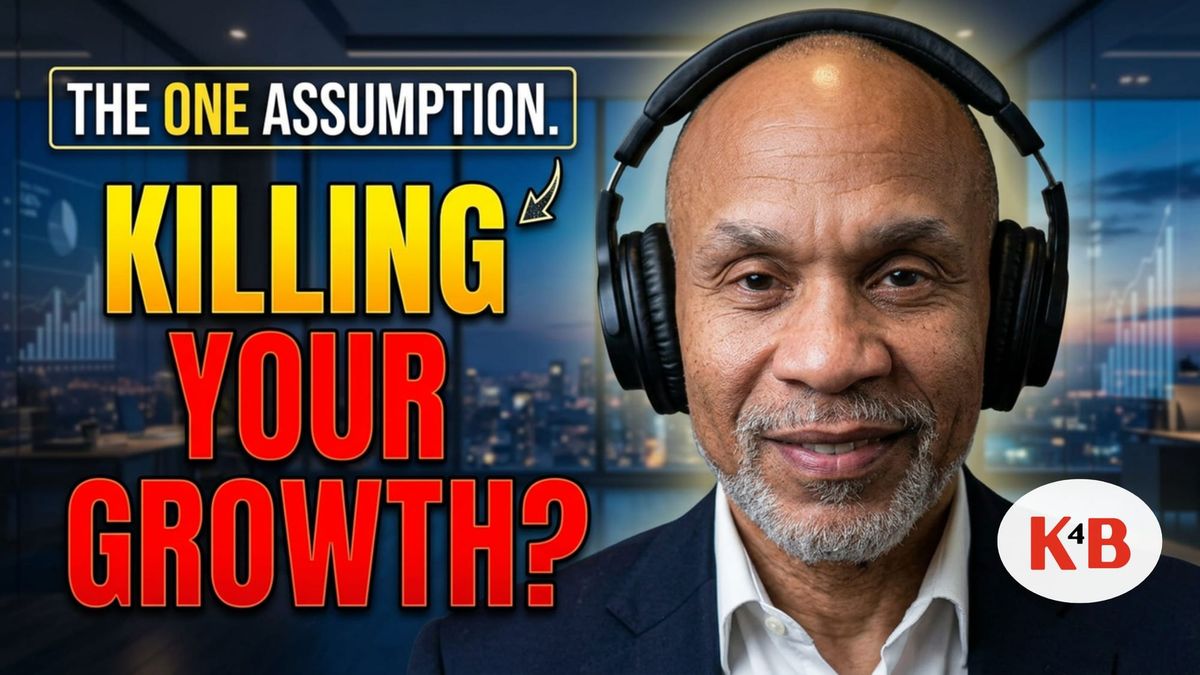
The Assumption That's Killing Your Business Growth | Ted Santos
Ted Santos reveals why the assumption you've never questioned is probably the ceiling your business keeps hitting — and exactly how to find it and dismantle it.

Hosts: Bernie Franzgrote & Wayne Pratt
Ted Santos on Knack 4 Business explains why unquestioned assumptions — not strategy — block most leaders from real business growth. Season 4, Episode 058.
GROWTH CATEGORY: Leadership & Ops
Most businesses don't stall because the leader isn't working hard enough. They stall because the leader is running on an assumption they formed years ago — and never stopped to question. Ted Santos has spent his career finding those assumptions in CEOs, executives, and leadership teams. Then he dismantles them. In this episode of Knack 4 Business, he shows exactly how that works.
Watch the full conversation here:
Who This Is For
SMB owners / Solopreneurs / Corporate escapees / Leaders building systems
If you've ever felt like your business should be further along — and you can't figure out why it isn't — this episode is for you.
Key Lessons
1. Creating problems on purpose is a CEO's actual job
Ted is direct about this: if you're not intentionally creating problems as a CEO, you're not leading — you're managing. The difference matters. A manager controls what occurs in time and space. A leader disrupts it.
He backs this up with Henry Ford, who didn't improve horse-drawn transport — he declared that most households would own a car and worked backward until he'd dropped the price from $1,500 to under $250. Robert Goddard said man would reach the moon in the 1920s. The New York Times said he had the intelligence of a child. In 1969 they issued a correction. Both Ford and Goddard were doing the same thing: declaring a future that their current paradigm couldn't see, then creating the problems that future required.
2. One event from your past is probably running your business right now
Ted worked with a mortgage executive in his early sixties who was on the verge of being fired. Smart, experienced, great with people — and completely unable to close a deal. He'd break the ice in every meeting, get everyone laughing, and watch them leave without signing.
The root cause: a single moment at age thirteen, sitting in the back of a car with older guys, cracking a joke to fit in. He decided in seconds that being the funny guy was how you survived when you didn't belong. Decades later, every time he sat across from investors, that same response fired automatically. He couldn't stop it because he didn't know it was happening.
After six months with Ted, he doubled his productivity. Then doubled it again. Not from a new script — from finally seeing the belief and choosing something different.
3. Research is often just a defence against looking incompetent
When leaders introduce a genuine breakthrough — something outside the current way of doing things — teams often respond with research. They spend weeks finding reasons it won't work. Ted's read on this is sharp: the research isn't about the idea. It's self-protection. People are afraid of looking incompetent in a new paradigm where their current skills don't transfer.
The result is always the same. The ceiling holds. The initiative dies. And everyone goes back to what they already know how to do.
Practical Steps
- Identify one area where you've researched your way out of a decision. Ask yourself: did the research come first, or did the conclusion?
- Introduce one problem on purpose in your next leadership meeting. Not a crisis — a question that disrupts a standing assumption. Observe what happens.
- Trace one recurring behaviour under pressure. Something you do automatically. Ask yourself: when did I first decide this was the right response — and is it still serving me?
About the Guest
Ted Santos is the founder and CEO of Turnaround IP and the creator of the Disruptive Leadership Model — a framework that trains leaders to identify and dismantle the limiting beliefs blocking individual and organisational performance. He has served as Chief Operating Officer in multiple organisations and has worked with leaders and companies across the United States.
His book, Here's Why You Can't Find Love, applies the same mindset technology to intimate relationships — and is written as a live dialogue between Ted and five interviewers, making it read like a workshop rather than a lecture. Available on Amazon, Barnes & Noble, and all major electronic bookstores.
Connect with Ted: turnaroundip.com | LinkedIn | Blog | Articles
Listen on Audio
FAQ
Q: What is the Disruptive Leadership Model? It's a framework Ted Santos developed to help CEOs and executives identify the inherited beliefs and unquestioned assumptions shaping their leadership. The process uses targeted questions to help leaders discover and dismantle those beliefs — not through instruction, but through their own recognition of them.
Q: How long does it take to see results using Ted's approach? In the mortgage executive case Ted shared on the show, the client doubled his productivity in the first three months and doubled it again in the next three. Results depend on the individual and the depth of the work, but the pattern Ted describes is significant change within a matter of months — not years.
Q: Can this approach work for small business owners, not just large corporations? Yes. Ted works across industries and organisation sizes. The limiting beliefs he addresses are human — not corporate. A solopreneur or SMB owner carries the same patterns a Fortune 500 executive does. The scale of the organisation changes. The mechanism doesn't.
K4B Acknowledgements
Carl Richards — Podcast Solutions Made Simple
Fred Crouch — Property Wizard Podcast
Jovan Strika — @Hive
Melanie Webber