The Pattern That Stops Farmers From Adopting Change
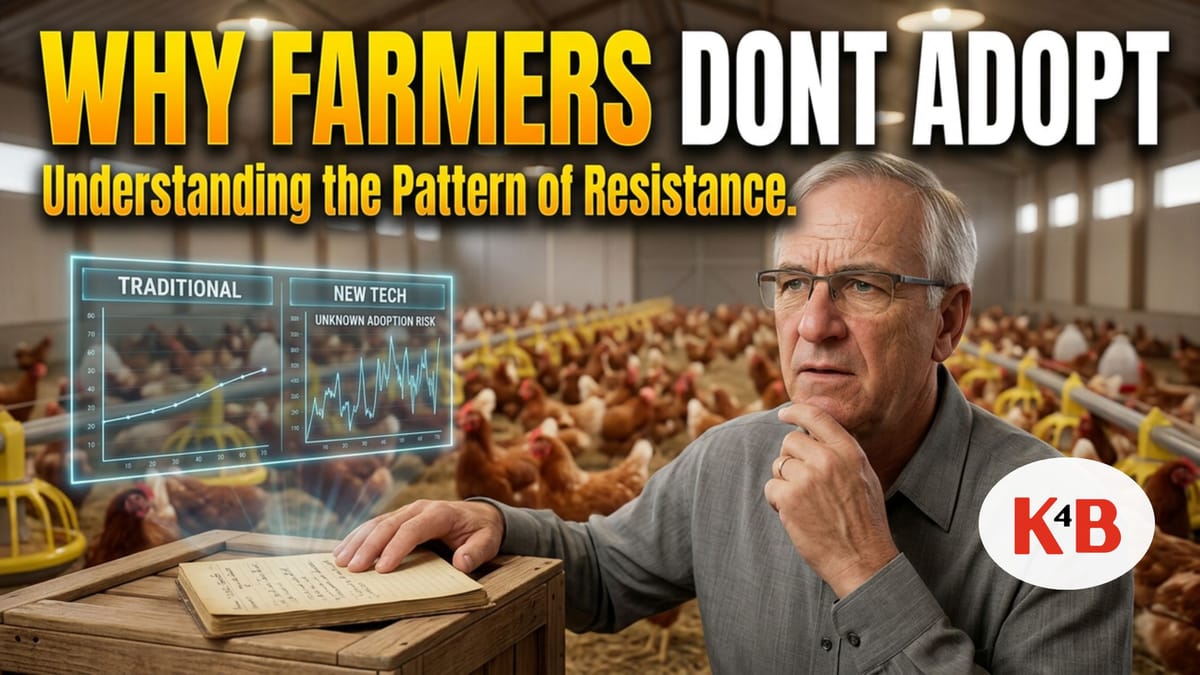
John Fielding spent 40 years in high tech before bringing nanobubble technology to Canadian farmers. This is what he learned about selling innovation into a market that doesn't trust change.

Hosts: Bernie Franzgrote & Wayne Pratt
GROWTH CATEGORY: Sales & Revenue
Your product works. The data is solid. You even have a customer willing to share his results.
And still — the phone isn't ringing.
John Fielding knows that feeling better than most. In this episode of Knack 4 Business, the founder of NanoBubble Control Systems walks through what it really takes to sell a breakthrough technology into one of the most resistant markets in Canada — and what every entrepreneur can learn from the pattern he found there.
Watch the full conversation here
WHO THIS IS FOR
This episode is for SMB owners, solopreneurs, corporate escapees, and leaders building systems — especially anyone selling something new into a market that doesn't move fast.
Key Lessons
Lead with the outcome, not the technology.
John used to open every conversation with nanobubbles. He'd explain the science — bubbles smaller than 200 nanometers, billions per milliliter, negatively charged, suspended in water for months. And people's eyes would glaze over.
He switched. Now he opens with: more oxygen in the water, healthier animals, fewer losses. Same technology. Completely different response. The lesson is simple — buyers don't buy how it works. They buy what it does for them.
The hero project is your best sales tool.
In a trust-deficit market, data is currency. John identified willing farmers — ones ready to take a risk in exchange for real results — and subsidized their installs to generate documented outcomes. One farmer's 70% reduction in liver and respiratory disease is now the centrepiece of every new conversation. That one hero project is doing more sales work than any pitch deck ever could.
Your network is closing deals you don't know about yet.
John's best lead didn't come from cold outreach, a LinkedIn campaign, or a trade show booth. It came from a stranger at an investment event whose university friend happened to manage one of the largest egg farms in the region. He showed up. He talked. He stayed present. That's it. Entrepreneurs consistently underestimate how much their network is working on their behalf — even in rooms that seem unrelated to their market.
Practical Steps
- Rewrite your pitch opening. Remove all technical language from your first 60 seconds. Replace it with one clear outcome your buyer cares about. Test it in your next three conversations.
- Find one hero customer. Identify the most willing prospect in your pipeline. Offer to subsidize or reduce the barrier to entry in exchange for documented results and data sharing. One real outcome beats ten promises.
- Show up in rooms that don't seem relevant. The investment event John attended had nothing to do with chicken farms. He went anyway. Identify two events this month outside your usual circle and put them in your calendar.
About the Guest
John Fielding is the founder of NanoBubble Control Systems, a Canadian company bringing advanced water technology to the agriculture and disinfection markets. With over 40 years of experience in high tech — including roles at Mitel, Nortel, and Ontario Centres of Innovation — John has mentored hundreds of startups and teaches entrepreneurship at the Telfer School of Management at the University of Ottawa. He helps livestock farmers reduce disease, improve biosecurity, and build stronger, healthier operations using nanobubble technology.
Listen on Audio
- Listen now
- Comment on the Knack 4 Business LinkedIn page
- Visit Knack 4 Business
- Try Web Indexer — find K4B episodes faster and book a meeting
- Join Canada Growth Network — full GHL CRM + community. $1 CAD first month. $47 CAD/month. No lock-in.
- Explore Gentry Learning — real estate investing platform
- Listen to Property Wizard podcast by Gentry Learning
FAQ
What is nanobubble technology and how does it work? Nanobubbles are extremely small gas bubbles — under 200 nanometers — that stay suspended in water for weeks or months. They transfer gas into water at 95% efficiency, making them far more effective than traditional aeration. When the gas is ozone, the result is a powerful on-demand disinfectant that outperforms chlorine significantly.
Why are farmers slow to adopt new technology like this? Farmers are risk-averse because their livelihood depends on every decision they make. They need proven results before committing to change — which is why building data through hero projects, and working with government agencies to validate the technology, is essential before expecting wide adoption.
How does ozone disinfection compare to chlorine for farm biosecurity? Ozone is hundreds of times more powerful than chlorine and reacts approximately 3,000 times faster. It leaves no chemical residue and is safe to handle when dissolved in water. For farm disinfection — footwear, troughs, irrigation systems — it offers a faster, cleaner, and more effective alternative to conventional chemicals like chlorine or formaldehyde.
Acknowledgements
Carl Richards — Podcast Solutions Made Simple
Fred Crouch — Property Wizard
Jovan Strika — @Hive
Melanie Webber — business partner