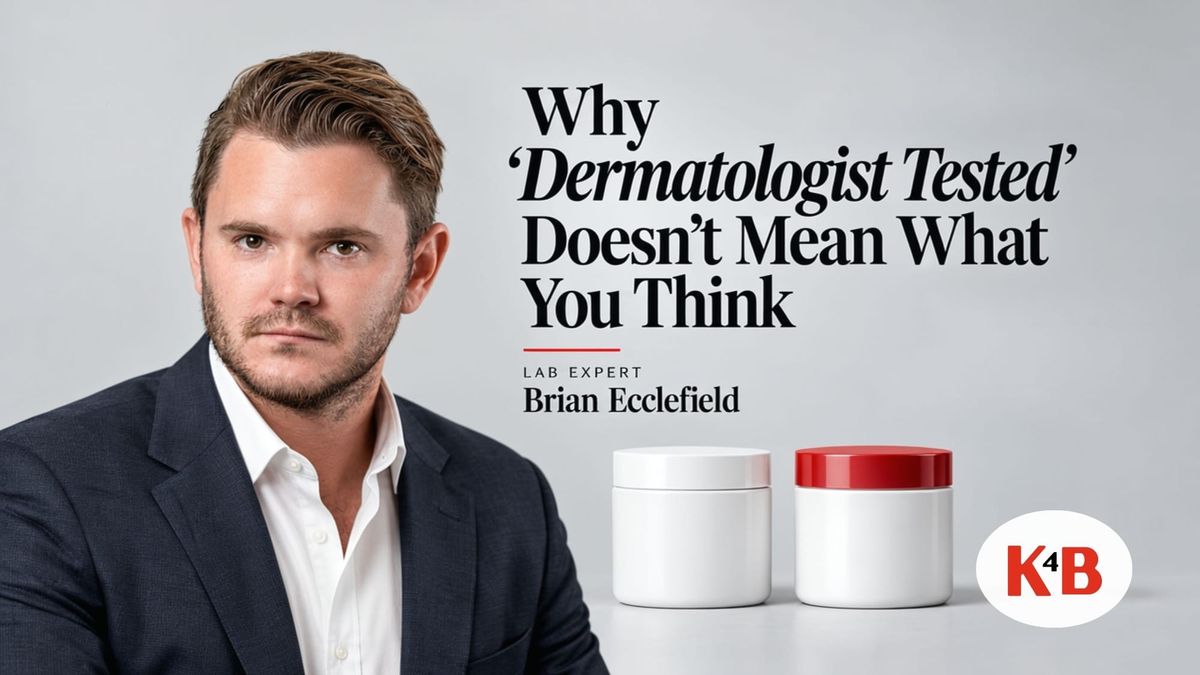
Why 'Dermatologist Tested' Doesn't Mean What You Think.
"Dermatologist tested" does not mean a skin doctor approved it. Brian Ecclefield explains how to prove skincare claims with real clinical data.

Host: Bernie Franzgrote
Learn what 'dermatologist tested' really means. Brian Ecclefield shares how to prove skincare claims on Knack 4 Business, from blind testing to vetting a lab.
GROWTH CATEGORY: Marketing & Branding
Brought to you by @Hive, Profit10, and Gentry Learning.
You pick up a skincare bottle. The label says "dermatologist tested." It feels like a promise. Is it?
Brian Ecclefield spent his career inside the labs that test those claims. He knows what a claim really took to earn, and what it didn't.
Brian is the founder of an FDA-registered clinical testing lab in Teaneck, New Jersey. He helps skincare, hair care, and personal care brands back their claims with real clinical data. He says product marketing should follow the proof, not lead it. In this episode, he explains how the testing works, how to vet a lab, and how small brands can start without wasting money.
Watch the full conversation here:
Many skincare claims are not backed by proof. Brian Ecclefield, founder of FDA-registered clinical testing lab Validated Claim Support, explains what "dermatologist tested" really means and how blind testing works. Readers learn how to spot weak claims, vet a testing lab, and test each final formula before they market it.
Who this is for
SMB owners, solopreneurs, and leaders building systems. If you make or sell skincare, hair care, or personal care products, this one is for you.
Key Lessons
1. Claim words sit on a ladder. "Dermatologist tested" means a skin doctor was involved somewhere. "Approved" means a dermatologist reviewed the data. "Recommended" is strongest, because it usually means several dermatologists blind tested it. Look at the exact word before you trust it.
2. One study can't prove every claim. Acne and anti-aging draw different groups of people. If you pack both into one panel, you can spend $30,000 to $50,000 and learn very little. Two focused panels cost more up front, but you get usable data from each.
3. Each final formula needs its own test. A supplier's study applies to the supplier's ingredient. Once you mix it into your formula, the result can change. If you switch a preservative or supplier, plan to retest.
Practical Steps
- Search the FDA debarment list and the drug establishment list for any lab you plan to use. Search the address and the owners too, not only the name.
- Start with basic safety tests on each product. Brian says these can run about $1,500 per product.
- When you shop, look for "non-comedogenic" and "safe for sensitive skin." Then check whether the brand shares its clinical data.
About the Guest
Brian Ecclefield is the founder of Validated Claim Support, a clinical testing lab for personal care brands. Connect: LinkedIn · Instagram · YouTube
Listen on Audio
Partners on this episode
@Hive: real-world business networking, in person and online.
Profit10: a free ten-question Profit Snapshot that shows where profit leaks.
Gentry Learning: real estate courses, listings, and a free newsletter.
FAQ
Does "dermatologist tested" mean a dermatologist approved the product?
No. It means a skin doctor was involved somewhere in the testing. "Approved" means one reviewed the data. "Recommended" is the strongest.
Can a small skincare brand afford clinical testing?
Yes, if it starts small. Basic safety testing can run about $1,500 per product. Build up to claims like fine lines later.
Do I need to retest if I change an ingredient?
Usually, yes. Skin is the biggest variable. A new supplier or preservative can change the result, so plan a new batch test.
- Join Canada Growth Network: $47 CDN, a robust CRM plus community
- Web Indexer: quick install chatbot. Info 24/7 for visitors. Install it today.
- Browse all episodes (K4B / ETW / CGN)
- Search K4B episodes by topic: this uses that Web Indexer!
- Want to be a guest? Register here
K4B Acknowledgements
Carl Richards · Fred Crouch · Jovan Strika — @Hive · Melanie Webber