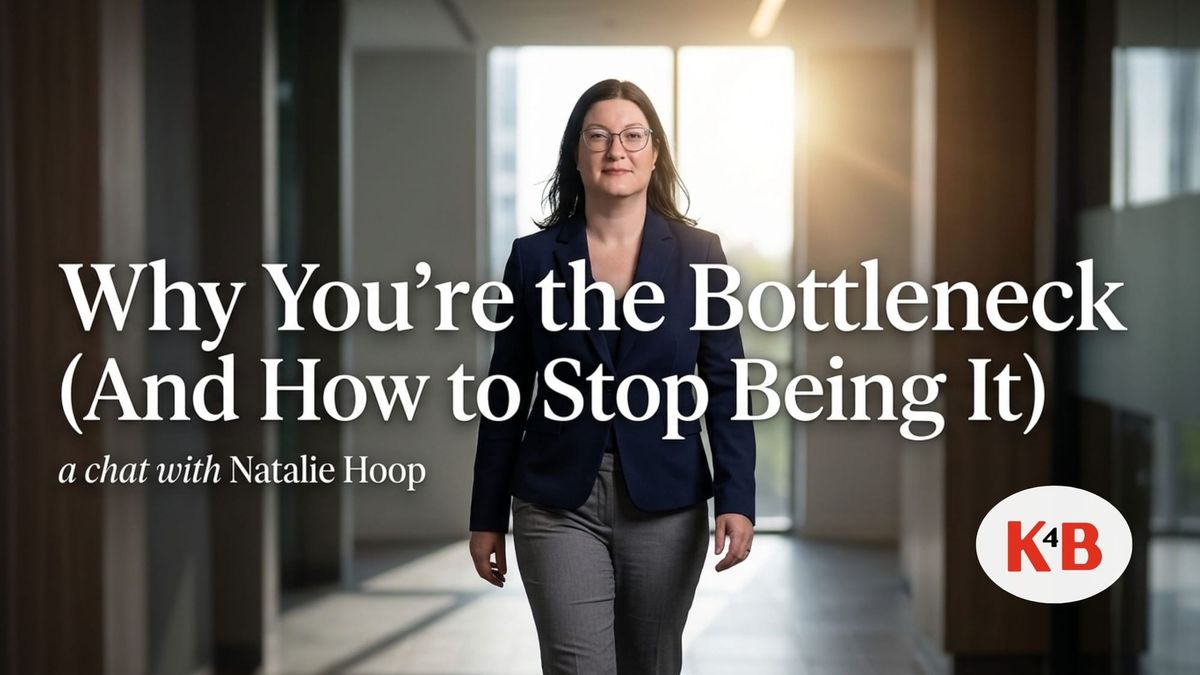
Why You're the Bottleneck (And How to Stop Being It) | K4B
Natalie Hoop is a fractional COO who helps Seed to Series B startups remove the founder bottleneck and build the business systems that unlock real growth. This episode is your map.

Host: Bernie Franzgrote
Fractional COO Natalie Hoop on how to remove the founder bottleneck, build business systems, and create operational clarity that unlocks startup growth.
GROWTH CATEGORY: Leadership & Ops
Brought to you by Profit10™, Notionhive, and Profit10™ Partner Program.

Take the free 5 minute Profit Snapshot. Ten questions. Find out what's really holding your business back.
You're working harder than ever. The team is still missing deadlines. The business isn't growing the way it should. And somewhere in the back of your mind, you already know why — but it's hard to say out loud.
Natalie Hoop can say it plainly. She's a fractional COO who walks into Seed to Series B startups at the exact moment chaos starts costing money. In almost every company she enters, she finds the same thing. The founder built the bottleneck — not on purpose, but because they didn't know another way. She helps founders see it, fix it, and hand off enough of it that the business can finally grow.
Watch the full conversation here:
ANSWER CAPSULE:
Most founders hit a growth ceiling not because of the market — but because every decision runs through them. Natalie Hoop is a fractional COO who works with Seed to Series B startups to identify operational gaps, rebuild business systems, and remove the founder as the single point of failure — delivering results like a 238% sales increase within four months.
Who This Is For
Founders feeling stretched. Startup operators hitting a ceiling. Senior leaders considering the fractional model. Solopreneurs building for scale.
Key Lessons
1. The bottleneck is almost always the founder
When every decision runs through one person, the whole business slows to that person's bandwidth. Natalie's first fractional client worked 80 hours a week and still missed every target. The problem wasn't effort. He'd built a company where nothing could move without him — because that's the only model he knew. He had a vision and no structure for sharing it. The system was designed around him by accident. And it was costing him everything.
2. Operational clarity is not a dashboard
Dashboards show you what already happened. They're reactive by design. Real operational clarity answers a different question: how does this company actually function? Who can decide what? What needs approval and what doesn't? Once people know the answer, they stop pushing everything upward. Natalie describes companies where employees are afraid to make even small moves — not because they lack capability, but because no one has ever told them what they're free to do. Clarity fixes that. And it fixes it fast.
3. Give away the Legos before someone makes you
At Series B, boards replace founders who can't grow beyond their original role. It happens regularly. The founders who avoid that outcome are the ones who started handing things off early — not just the tasks they hated, but the ones they were best at. Natalie sends almost every client a piece by Molly Graham called "Give Away Your Legos." One client read it, wrote a LinkedIn post about it, and changed her behaviour the same week. The shift isn't slow when someone finally sees it.
Practical Steps
1. Start with your OKRs, not your org chart. Before any process work, Natalie gets clear on where the business needs to be in one year. Without that, changes don't compound — they just move things around. Know the destination before you redesign the road.
2. Walk your own process as an outsider. Go from first customer contact to final delivery and watch where things stall. The root cause is usually visible from that angle. Everyone inside the business is too close to see it. You've been staring at it for months. A fresh set of eyes finds it in an afternoon.
3. Build one visible win in 90 days. Find a high-impact area where the founder is the only decision-maker and rebuild the handoff cleanly. One visible win changes the trust dynamic faster than any system doc or strategy deck. The founder sees it work. They start to let go. And then you build on that.
About the Guest
Natalie Hoop is a fractional COO and strategic operations partner who helps Seed to Series B startups replace chaos with structure. She removes bottlenecks, rebuilds revenue and delivery systems, and creates the operational clarity that unlocks scale. Her Fractional Launch Lab helps senior leaders exit corporate life and build sustainable fractional practices of their own. The Fractional Reset is a four-week program for existing fractionals who need to rebuild their business model.
Connect with Natalie: nataliehoop.com | LinkedIn | Instagram | The Ops Edge Newsletter
Listen on Audio
Listen on Simplecast
Browse all episodes
Partners on this episode
Profit10™ — Take the free Profit Snapshot. Ten questions. Find out what's really holding your business back.
Notionhive — Websites built to perform. If your site isn't generating leads, it's time for a rethink.
Profit10™ Partner Program — Coaches and fractional advisors: turn discovery calls into paid advisory conversations with a structured diagnostic.
FAQ
Q: What does a fractional COO actually do inside a company?
A fractional COO comes in part-time — usually 10 to 20 hours a week — to create operational strategy, identify bottlenecks, and rebuild the systems that allow the business to grow without the founder making every decision. The goal is always to graduate the company to a point where it no longer needs them.
Q: How do I know if I need a fractional COO or a full-time hire?
Natalie's test: when the clothes no longer fit — you're scaling, things are breaking, and you can't clearly see the constraint. A fractional COO brings senior-level experience at a fraction of the cost. And the goal is to leave behind systems a junior person can maintain.
Q: How do I find a fractional COO I can trust?
Two platforms worth knowing: Venturis and Knex. Both use structured matching and assessment processes. But Natalie's simplest advice — ask your network. Someone who's done this well will come highly referred. Trust travels faster than a marketplace listing.
- Join Canada Growth Network — $47 CDN/month. Real tools. Real community.
- Web Indexer — Quick install chatbot. Info 24/7 for visitors — install it today
- Browse all episodes (K4B / ETW / CGN)
- Search K4B episodes by topic — powered by the WebIndexer
- Want to be a guest? Register here