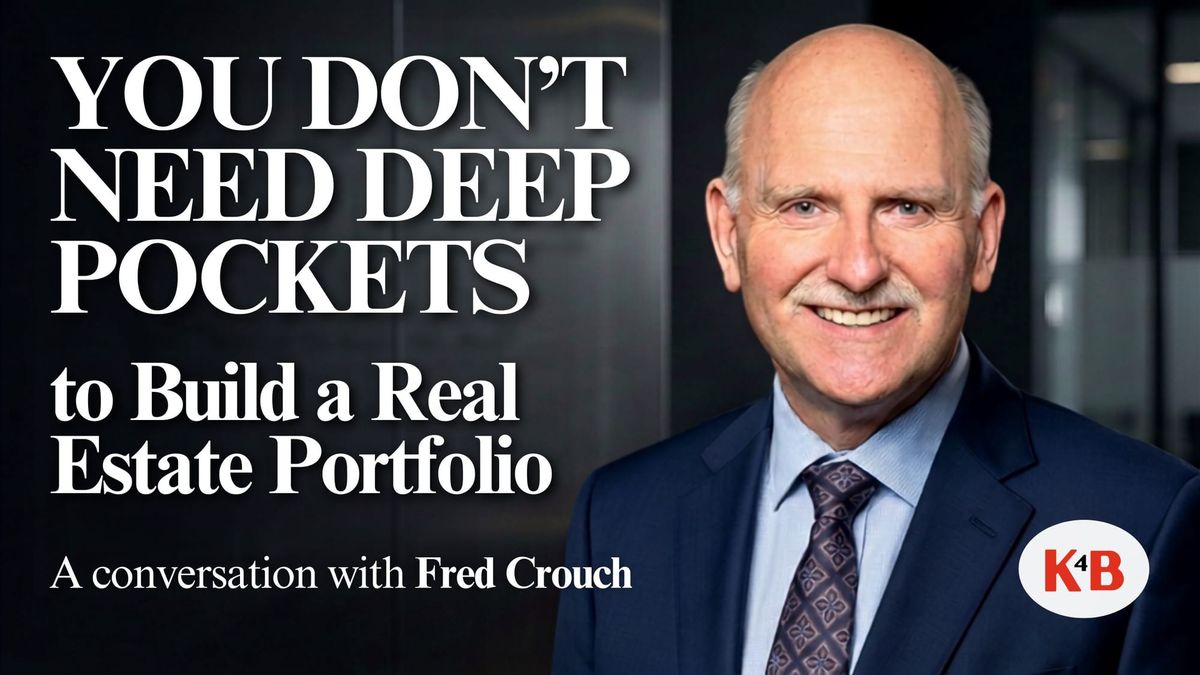
You Don't Need Deep Pockets to Build a Real Estate Portfolio | Fred Crouch
Fred Crouch returns for his fifth K4B appearance to break down the investing systems everyday buyers use: leverage, co-tenancy, and forced appreciation — in plain language.

Host: Bernie Franzgrote
Fred Crouch breaks down leverage, co-tenancy, and forced appreciation — the real tools everyday investors use to build property wealth.
GROWTH CATEGORY: Real Estate & Wealth Building
Brought to you by Gentry Learning, Profit10™, and Canada Growth Network.

Gentry Learning - Property Investing Tips
Real estate education built by Fred Crouch. Courses, an Investor Club, active listings, and the Property Wise newsletter. The practical path into property.
You keep telling yourself you'll buy property when the time is right. When rates drop. When you have more saved. When things settle down. But the investors already in the market aren't waiting for any of that. They figured out something most people miss — and it has nothing to do with how much money they started with.
Fred Crouch has spent 36+ years in commercial real estate watching everyday buyers build real wealth with the same tools the big players use. In this episode of Knack 4 Business, he lays out the whole framework — from how leverage actually works, to the ownership structures that protect your investment and your family.
Watch the full conversation here:
WHO THIS IS FOR
SMB owners thinking about their first income property. Solopreneurs looking to build wealth outside their business. Investors who want to diversify without going all-in on one asset. Anyone who keeps saying "someday" about real estate.
Key Lessons
1. Leverage is what makes real estate unlike anything else
When you put 25% down on a $400,000 property, your return isn't calculated on the $100,000 you invested. It's calculated on the full $400,000. A 4% market increase gives you $16,000 in appreciation — not $4,000. That gap is leverage. And no GIC, savings account, or mutual fund works that way. Your tenants cover the mortgage. The asset appreciates. You build equity on the whole thing — not just your slice.
2. Forced appreciation is equity you manufacture
Natural appreciation is what happens when you wait and the market moves. Forced appreciation is what happens when you buy a property with a problem you can solve — outdated use, deferred maintenance, underperforming income — and fix it. Fred calls it making a silk purse from a sow's ear. The result is faster equity growth that doesn't depend on market timing. You control it. That's the point.
3. Co-tenancy lets you diversify without going deeper into your pocket
Instead of putting $100,000 into one property, a co-tenancy lets you contribute $25,000 alongside three partners and buy the same asset. Then take the remaining $75,000 and enter two more co-tenancies across different property types. Now you hold a share in a condo, a townhouse, and a strip plaza — all with the same capital. Risk is spread. Costs are shared. And if one market softens, the others may not.
Practical Steps
1. Run the leverage math on any property you're considering
Take the purchase price. Multiply it by your expected annual appreciation rate. That's your real return — not just the return on your down payment. Compare it against what the same money earns sitting in a GIC or savings account. The difference is why experienced investors keep buying.
2. Find one property that qualifies for forced appreciation
Look for functional obsolescence, deferred maintenance, or underperforming tenancies in a desirable area. Have two appraisals done. Run the numbers on what it costs to improve versus what comparable properties sell for. If the spread is there, the deal is worth a serious look.
3. Talk to a commercial realtor, an accountant, and a lawyer before you sign anything
Fred's minimum team for any income property: a realtor who knows the market, an accountant who understands income property tax, and a lawyer who can structure the ownership correctly. Co-tenancy agreements in particular need to be drafted properly — who can sell, what triggers a buyout, how disputes are resolved. Get those three in place first.
Descript is the tool I use to edit audio and repurpose content fast.
About the Guest
Fred Crouch is the broker of record and managing director of Gentry Real Estate Services, with over 36+ years in commercial real estate across Canada. He created Gentry Learning to give everyday investors access to the same framework institutional players use — through courses, an Investor Club, active listings, and the Property Wise newsletter. He also hosts the Property Wizard Podcast, available on Spotify and at gentrylearning.com. Connect with Fred on LinkedIn or follow Gentry Learning on Instagram.
Fred solves one problem: the gap between knowing real estate works and actually knowing how to get in.
Listen on Audio
Listen on Simplecast
Browse all episodes
Partners on this episode
Gentry Learning — Real estate education built by Fred Crouch. Courses, an Investor Club, active listings, and the Property Wise newsletter. The practical path into property.
Profit10™ — Take the free Profit Snapshot. Ten questions that show you exactly where your business is strong and where it's leaking profit. No cost. No sales call.
Canada Growth Network — Business connections and a full done-for-you automation stack for $47/month Canadian. Real tools. Real people. Start your trial for $1.
FAQ
Q: Do I need a lot of money to start investing in real estate?
No. Co-tenancy structures let you pool capital with other investors and buy into properties at a fraction of the full cost. Fred has done co-tenancies with as few as two people and as many as fifteen. The entry point is lower than most people assume.
Q: What's the difference between natural and forced appreciation?
Natural appreciation is what the market gives you over time — typically two to four percent annually, sometimes more in hot markets. Forced appreciation is what you create by improving the property — fixing deferred maintenance, improving tenancies, or changing the use. Forced appreciation is faster, more controllable, and doesn't depend on market timing.
Q: What is mortgage position and why does it matter?
When multiple mortgages are registered on a property, they're ranked by the order they were registered. A first mortgage gets paid first if the property is sold or refinanced. A third or fourth mortgage may get nothing if there isn't enough money to go around. Fred warns against investing in projects where you're far down the mortgage stack — your security is only as good as your position.
- Join Canada Growth Network $47 CDN robust CRM stack + Community
- Web Indexer quick install chat bot – info 24/7 for visitors
- Browse all episodes (K4B / ETW / CGN)
- Search K4B episodes by topic – uses Web Indexer
- Want to be a guest? Register here