You're Not Undercharging — You're Pricing Wrong | CGN
John Ray helps consultants and coaches stop pricing by the hour and start charging for client outcomes. Six red flags, a value dialogue framework, and a good-better-best model that changes how you price everything.

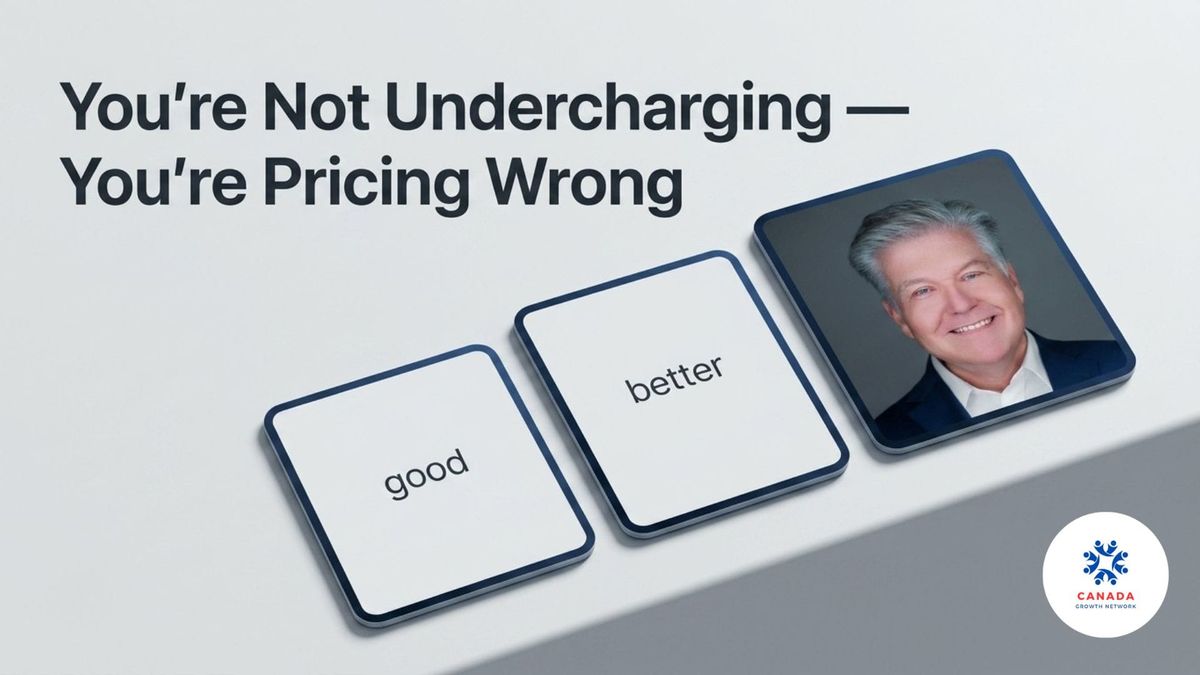
Hosts: Percy Barr, Wayne Pratt and Bernie Franzgrote
John Ray shows consultants, coaches, and professional service providers how to shift from hourly rates to value-based pricing and charge what they're worth.
GROWTH CATEGORY: Sales & Revenue
Brought to you by Canada Growth Network, Profit10™, and WebIndexer.

Business community with a full CRM and automation suite. Real tools. Real people. $47 CAD/month.
You've been told to charge more. Maybe you've even tried. But if your pricing model is still built around hours, credentials, and one flat rate — you're solving the wrong problem.
John Ray has spent years helping consultants, coaches, accountants, and lawyers get clear on the value they deliver and price their work to match. His book, The Generosity Mindset, came out of his own experience — thirty years on Wall Street, then starting a practice and having no idea what to charge. In this CGN Power Hour, he breaks it all down practically and clearly.
Watch the full conversation here:
ANSWER CAPSULE
Most professional service providers undercharge not because they lack confidence but because they anchor fees to time and credentials instead of client outcomes. John Ray, author of The Generosity Mindset and a thirty-year Wall Street veteran, shares a practical framework for shifting to value-based pricing — including six red flags, a value dialogue approach, and a good-better-best options model that helps consultants and coaches charge what their expertise is worth.
WHO THIS IS FOR
Consultants · Coaches · Accountants · Lawyers · Any professional service provider who has ever discounted their fees or felt awkward talking about price.
Key Lessons
1. Your pricing model is the problem — not your confidence
John is direct on this. Most providers think they need more courage to charge more. What they actually need is a different model. Hourly rates anchor your value to time — and your expertise is not measured by the clock. When you price by the hour, you become a commodity whether you mean to or not. The fix starts with removing the hourly rate entirely and building options around outcomes instead.
2. Clients see value where you don't think to look
John put it plainly: "I've never seen a client write a review that said, I loved the way they filled out the tax return." What clients actually value are the intangibles — responsiveness, clarity, the feeling that someone has their back. These are things providers do every day without thinking about them. Surfacing those intangibles, understanding them, and building them into how you talk about your work is where pricing confidence actually comes from.
3. The value dialogue is a system, not a conversation
Better pricing doesn't come from a rate increase. It comes from asking better questions before you ever name a number. Why does this need to happen now? What would happen if you waited? Why didn't this get done a year ago? What does your spouse think about this? These questions reveal what the outcome is worth to the client — and that's the number that matters. John calls it a value dialogue, and it's ongoing, not a one-time event.
Practical Steps
1. Audit your six red flags this week
Pull up your pricing page, your intake process, and your last five proposals. Count how many of John's six red flags are present — hourly rates, one price for all, no options, a hundred percent yes rate, talking about yourself instead of client problems. Even two or three flags is enough to start the shift.
2. Build a good-better-best option structure
Before your next sales conversation, design three ways to engage with you — not three hourly packages, but three outcome-based tiers. What does a client get at the basic level? What do they get at the premium level? Structure each tier around what changes for the client, not what you do.
3. Start asking one new question in discovery
Pick one question from John's value dialogue and use it in your next client conversation. "Why does this need to happen now?" is a strong starting point. Listen to what the client says. That answer will tell you more about what to charge than any rate calculator will.
About the Guest
John Ray helps consultants, coaches, accountants, lawyers, and other professional service providers get clear on the value they deliver and price their work to match. After thirty years on Wall Street, he started his own advisory practice — and discovered there was almost nowhere to go for help with pricing expertise. That gap led him to write The Generosity Mindset, host the Price and Value Journey Podcast, and build an advisory practice focused on helping experts charge what they're worth. Connect with him on LinkedIn or through his blog and newsletter.
Listen on Audio
— Partners on this episode —
Canada Growth Network — Business community with a full CRM and automation suite. Real tools. Real people. $47 CAD/month.
Profit10™ — Free Profit Snapshot. Ten questions that show exactly where your business is strong and where profit is leaking.
WebIndexer — Turn your website into a 24/7 client-facing assistant. Quick install. Smart answers around the clock.
FAQ
Q: What's wrong with charging by the hour?
Hourly rates anchor your value to time — not to the outcome you deliver. They also cap your earning potential at however many hours exist in a day. Clients don't care how long something takes. They care what changes for them because of your work.
Q: How do I know if my pricing is too low?
John's clearest signal: if a hundred percent of your clients say yes to your price, it's too low. You need a certain number of nos to know your price is where it should be. Other signals include working too hard for too little, one flat rate for all clients, and marketing that talks about you instead of the problems you solve.
Q: What is a value dialogue and how do I start one?
A value dialogue is an ongoing conversation with clients about the outcomes your work creates for them. It starts with questions like — why does this need to happen now, what would happen if you waited, and why didn't this get addressed sooner. The answers reveal what the work is actually worth — and that's what you price to.
- Join Canada Growth Network — $47 CAD/month. A robust CRM + real community
- Web Indexer — Quick install chatbot. Info 24/7 for your website visitors
- Search K4B episodes by topic
- Want to be a guest? Register here
- Attend the CGN Monday Power Hour free