AI Agents Help Solo Operators | Allan Edmond
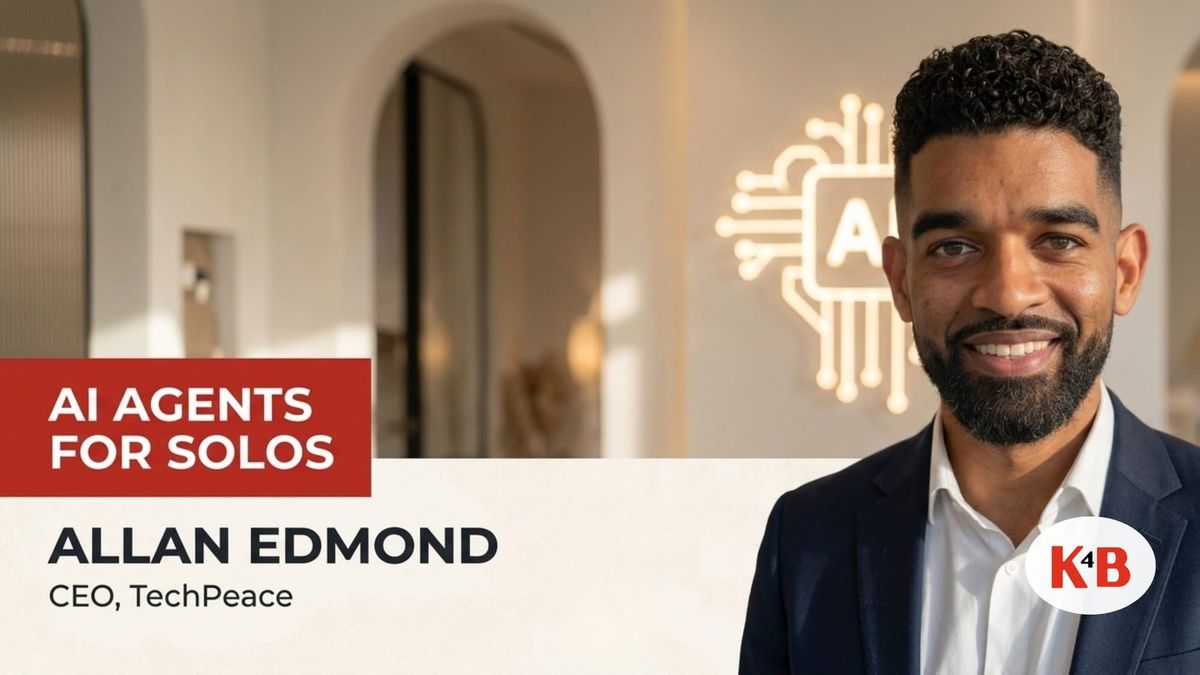
Allan Edmond of TechPeace explains how solo operators can use AI agents safely — without data leaks or a technical background.

Host: Bernie Franzgrote
TechPeace CEO Allan Edmond explains how solo operators can use AI agents and agentic coding safely — without data leaks or tech debt.
GROWTH CATEGORY: AI & Automation
Brought to you by @Hive, Profit10™, and Canada Growth Network.
Most solo operators are already doing the work of five people. The problem isn't effort. It's that the tools that could help them are either too risky, too complicated, or too easy to get wrong.
Allan Edmond, CEO of TechPeace, has spent the last several years helping non-technical founders build software and AI systems that actually work — and don't leak. In this episode of Knack 4 Business, he explains what AI agents really are, where the risks are hiding, and how to start using them safely this week.
Watch the full conversation here:
WHO THIS IS FOR
Solopreneurs / Non-technical founders / SMB owners / Leaders building systems on a lean team
Key Lessons
1. A convincing prototype is not a secure product.
Allan's clearest warning in this episode: tools like Lovable can produce a functional-looking app in hours. But a good UI is not a secure backend. He shared a real case — a parenting app where users could see other people's names, emails, and children's information. The builder didn't know what they didn't know. Allan's rule is clean: build internal tools yourself. The moment real users touch your software, bring in someone technical to review the architecture before you go live.
2. Three things make an AI agent dangerous — remove one and you've cut most of the risk.
The risk zone is when an agent has all three at once: access to your data, the ability to receive instructions, and the ability to communicate outside your system. Allan's fix is to remove external communication. Build internal-first. Forward specific emails to the agent rather than giving it full inbox access. Let it work inside your walls. His own agent handles his insurance claims — reads the PDF, logs in, submits the form — entirely inside his system.
3. Local AI models vs. cloud models is a trade-off, not a decision.
Running a local model (a downloadable file, roughly 7GB) gives you complete data isolation. Nothing leaves your machine. The trade-off is reasoning power — local models are less capable. Cloud providers like Anthropic and OpenAI offer maximum capability but require you to trust their data policies. Allan's approach: use local for reading and writing briefs; use cloud for actual reasoning and decision-making. Match the model to the task, not the mood.
Practical Steps
Three things you can do this week:
Step 1 — Audit your AI-built tools. If you've used Lovable, a no-code builder, or an AI coding tool to build something that real users touch — schedule a technical review before the next update. You don't need to rebuild it. You need someone to look at the backend.
Step 2 — Build one internal AI workflow. Pick a repetitive task that doesn't touch the outside world. An email you forward every week. A report you generate manually. A data entry step you dread. Use Claude Code or Codex, start with a prompt describing your goal, ask for a phased plan, and run phase one. — Make is a strong tool for connecting the workflow once your agent has a repeatable skill built. —
Step 3 — Book Allan's free consultation. If you have a prototype that hasn't launched, or a workflow you want to automate but aren't sure where to start, Allan offers a free session at calendly.com/allan-edmond/free-consultation. One conversation can tell you whether you need a full build, a review, or just a cleaner prompt.
About the Guest
Allan Edmond is the CEO of TechPeace, based in Grimsby, Ontario. He helps non-technical founders turn AI tools and custom software into working business systems — without the security gaps that come from building blind. One of fewer than 50 Glide Certified Experts globally, Allan has shipped 100+ apps for clients across femtech, real estate, and finance. He works in English and French and writes a daily AI newsletter — La Toolbox d'Allan — on Substack. Connect with him on LinkedIn or at techpeace.ca.
Listen on Audio
Listen on Simplecast
Browse all episodes
Partners on this episode
@Hive — Real-world business networking in person and online. Starter membership $99 CAD/year.
Profit10™ — Take the free Profit Snapshot and find out what's really holding your business back. Ten questions, no cost.
Canada Growth Network — Business connections plus GoHighLevel CRM for $47/month Canadian. Start your trial today.
FAQ
Q: What is an AI agent in plain language?
An AI agent is software that can take a task, think through it using an AI model, remember context between steps, and take actions — like submitting a form, reading a file, or sending an email — without you doing it manually each time.
Q: Is it safe for a non-technical founder to build their own AI tools?
For internal use only — yes. If the tool is just for you or your laptop, the risk is low. The moment other people use it, you need a technical review. Most security gaps come from not knowing what to look for, not from bad intentions.
Q: What's the difference between agentic coding and no-code tools?
No-code tools let you drag and drop to build apps visually. Agentic coding uses AI to write real code on your behalf — faster than traditional development and without the manual troubleshooting. The output is closer to what a developer would build, which means better architecture if guided correctly.