Margin Is the Only Metric That Matters | Paulo Knabben
Revenue feels good. Margin keeps the lights on. Paulo Knabben breaks down healthy margin ranges, the break-even math most owners miss, and when patience beats scale.

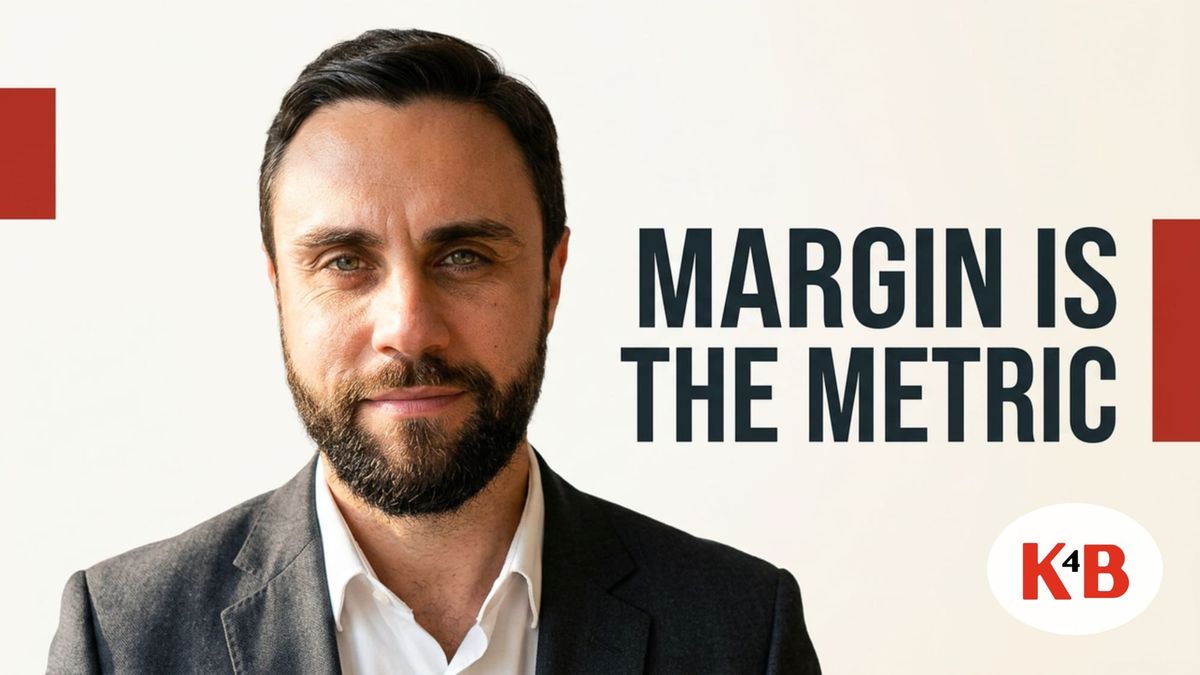
Hosts: Bernie Franzgrote and Wayne Pratt
Paulo Knabben on Knack 4 Business breaks down why margin beats revenue, healthy margin benchmarks by industry, and the break-even math.
GROWTH CATEGORY: Sales & Revenue
Revenue feels good. Margin keeps the lights on.
Most small business owners chase the wrong number, and Paulo Knabben — founder of Loocro — has helped over 150 companies fix that exact problem. His mantra is short: we don't scale ads, we scale margins.
Watch the full conversation here:
WHO THIS IS FOR
SMB owners. Solopreneurs. Corporate escapees. Service-based founders who feel busy but not profitable. Leaders building systems that scale without chaos.
KEY LESSONS
Lesson 1: Healthy margins are industry-specific — know yours
There's no universal margin number, but there are healthy ranges. Services should aim for 70%. Coaching can go higher. E-commerce often runs 30%. Coffee shops live in the 15–20% range if they're lucky. Manufacturing can be as thin as 3–5%.
The lesson isn't the exact number. It's knowing what healthy looks like in your industry, then aiming a little higher than average. That gap is your reinvestment money.
Lesson 2: Break-even isn't what most owners think it is
Paulo shared a story about a client happy to "break even" on $3,000 of ad spend. The client's actual margin was 40%. Which means $3,000 in ad spend needs $12,000 in sales to actually break even — not $3,000.
Most owners measure revenue when they should be measuring profit. If you run paid ads, do this math today.
Lesson 3: Sometimes the right move is to wait
Paulo described two cases where the answer wasn't to scale. One was an e-commerce client whose best-selling product was out of stock — scaling lower-margin replacements would have damaged the brand. The second was a course creator who wanted to scale on borrowed money. Paulo's advice: scale smaller for three months, save the profit, then reinvest.
Patience beats borrowing more often than founders want to admit.
PRACTICAL STEPS
- Calculate your real break-even number this week. Take your ad spend, divide by your margin percentage. That's the sales number you actually need. If it's higher than what you've been hitting, you have your answer.
- Pick one product or service and stress-test the price. Ask: does this price protect a healthy margin for my industry? If not, raise it, drop the product, or rework the delivery.
- Automate one margin-draining manual tasks.
ABOUT THE GUEST
Who Paulo helps: Small and medium business owners — services, e-commerce, B2B — with monthly revenue between $30K and $500K.
Problem he solves: Margin leaks, weak pricing, and unfocused paid traffic that burns money without building profit.
Why he cares: Paulo came up through pharmacy, an MBA, a failed cosmetics startup, and a course with his wife before finding paid traffic. He knows what it feels like to work hard for the wrong number. Loocro exists so other founders don't have to.
Connect with Paulo: Loocro | LinkedIn
Grab his free Profit Framework Session — 30 minutes, walk away with a PDF framework.
LISTEN ON AUDIO
Listen on Simplecast
Browse all episodes
- Visit Notionhive — websites built to convert
- Join Canada Growth Network — real connections + CRM for $47 CAD/month
- Try Make free — automate the busywork
- Search K4B episodes by topic
- Apply to be a guest
FAQ
Q: What's a healthy profit margin for a small business?
It depends on your industry. Services should aim for 70%. E-commerce often runs 30%. Coffee shops and food sit closer to 15–20%. Manufacturing can be 3–5%. Know your industry's range, then aim slightly above it.
Q: How do I calculate my real break-even on ad spend?
Take your ad spend and divide by your margin percentage. If you spend $3,000 and your margin is 40%, you need $7,500 in sales just to cover the ad — and $12,000 to fully break even when production costs are included.
Q: When should I NOT scale my business?
When supply chain or stock can't keep up, when the only path to scale is borrowed money, or when your margin math doesn't support more ad spend. Patience and reinvestment from profit usually beat scaling on debt.