The 80/20 Rule Most Founders Get Wrong | Cut This Instead
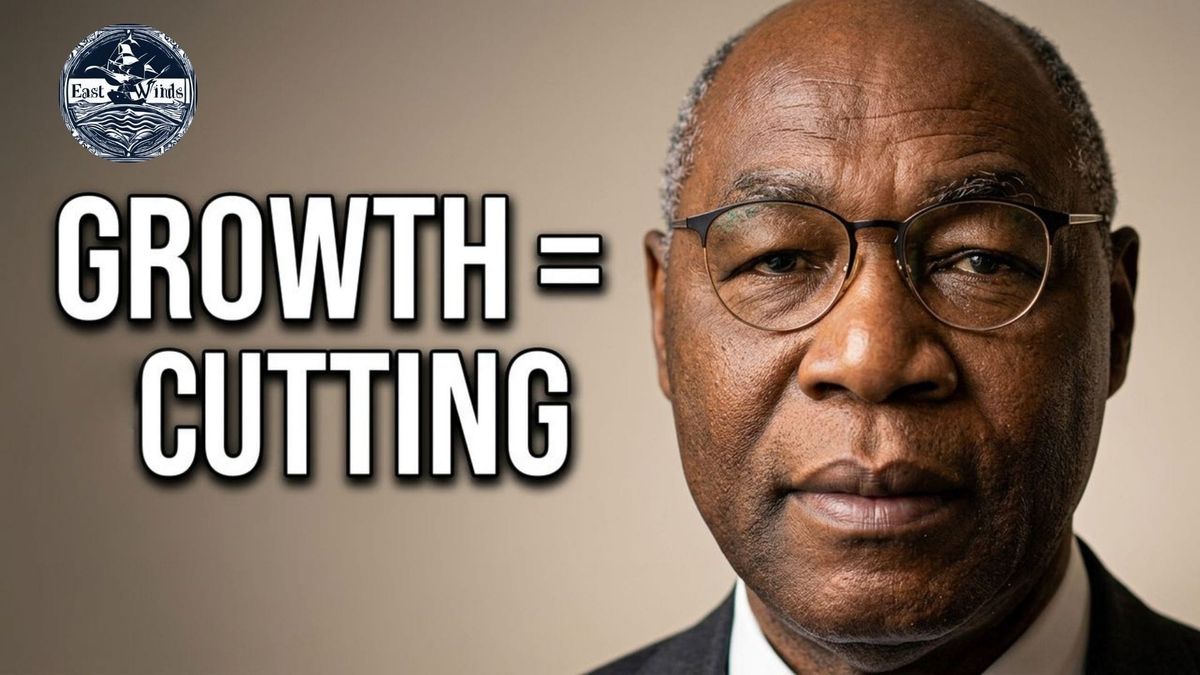
Most founders think growth means doing more. Mosongo Moukwa shows why that assumption costs you profit, and how seven levers can flip the math.

Hosts: Percy Barr, Wayne Pratt and Bernie Franzgrote
Mosongo Moukwa shows SMB owners how seven profit levers — moved by 10% each — can grow profitability by 54% on East Trade Winds.
GROWTH CATEGORY: Sales & Revenue
Brought to you by East Trade Winds, Profit10™, and Gentry Learning.

East Trade Winds
It’s a free weekly networking session: community first, sales second. Bring one challenge, bring one introduction.
Every Tuesday 8-9 AM EST
Most business owners think growth means doing more. Mosongo Moukwa disagrees — and he has the numbers to back it up.
In this East Trade Winds session, Mosongo — author, coach, and manufacturing expert — walks through a framework that helps SMB owners find the profit already sitting inside their business. No new hires. No new products. Just a sharper focus on the levers that actually move the needle.
Watch the full conversation here:
Who This Is For
SMB owners / Solopreneurs / Manufacturers / Leaders who are busy but not gaining ground as fast as their effort should suggest.
Key Lessons
1. Focus is a financial decision, not a mindset habit.
Most business owners spread their time across too many products, customers, and activities. The problem is not what is coming at you — it is what you are not willing to exclude. Mosongo uses the analogy of a flashlight in a dark room. Keep moving it everywhere and nothing is clear. Hold it still and you can see exactly what matters.
2. Seven levers compound when moved with intention.
Leads, conversion, closing rate, retention, transaction value, frequency of purchase, and cost. Improve each by 10% and profit climbs 54%. Push to 40% improvement and profitability grows 250%. A precision machine shop applied this thinking and added $400K in annual gross profit — without purchasing a new machine or hiring a single person. They stopped saying yes to low-margin work and concentrated on the 30% of customers who generated 75% of their profit.
3. Delayed decisions have a price you are already paying.
A cosmetics manufacturer knew they needed to raise prices. Raw material costs were up. Margins were tightening. They waited six months. When they finally made the call — not perfectly, not with full certainty — revenue improved by 6%, key retailers stayed, and the daily pressure lifted. The lesson is not that decisions are easy. It is that the cost of not deciding is real, measurable, and accumulating.
Practical Steps
1. Map your seven levers with your own numbers.
Take a sheet of paper. Write down your current leads, conversion rate, transaction value, frequency of purchase, and costs. Compute your revenue and profit. Then ask: what happens if each number moves by 10%? Run it. The result will tell you where to focus.
2. Identify your best 30%.
Look at your customer list and your product line. Which customers place repeat orders? Which products generate the most margin with the least complexity? Circle those. Everything outside that circle deserves a harder look.
3. Name the decision that is sitting.
You already know which one it is. Write it down. Then write what it is costing you — in time, energy, and profit — to leave it unmade. Set a date to decide. Not perfectly. Just decided.
About the Guest
Mosongo Moukwa is an author, coach, and manufacturing expert who has spent decades helping companies navigate high-stakes operational and strategic challenges. He works with leaders in plastics, advanced materials, and broader manufacturing who are facing stalled growth, inefficient processes, or unclear direction. His coaching sharpens leadership decision-making. His books and talks challenge the assumption that more activity equals more results.
Listen on Audio
Listen on Simplecast
Browse all episodes
— Partners on this episode —
East Trade Winds — Free weekly networking that actually goes somewhere. One challenge. One introduction. Every Tuesday 8–9 AM EST.
Profit10™ — Find out what is really holding your business back. Ten questions. No cost. No sales call. Just clarity on where your profit is leaking.
Gentry Learning — Real estate education with Fred Crouch. Listings | Investor Club | Free Newsletter
FAQ
Q: What are the seven profit levers Mosongo talks about?
They are leads, conversion rate, closing rate, retention, transaction value, frequency of purchase, and cost. Every business has all seven. The ones you move with intention are the ones that grow your profit.
Q: Do I need to improve all seven levers at once?
No. Mosongo's point is that even small, incremental improvements across each lever compound quickly. A 10% move across all seven generates a 54% profit gain. Start with the two or three where the gap is clearest.
Q: How do I know which customers or products to focus on?
Look at where your gross profit actually comes from. In Mosongo's manufacturing example, 75% of profit came from 30% of customers. Run that analysis on your own numbers. The answer is usually already in your data.
- Join Canada Growth Network – Super CRM / Community all $47 CAD /m
- Web Indexer webbot quick install for your page
- Search K4B episodes by topic
- Want to be a guest? Register here
- Join East Trade Winds free — Tuesdays 8–9 AM EST