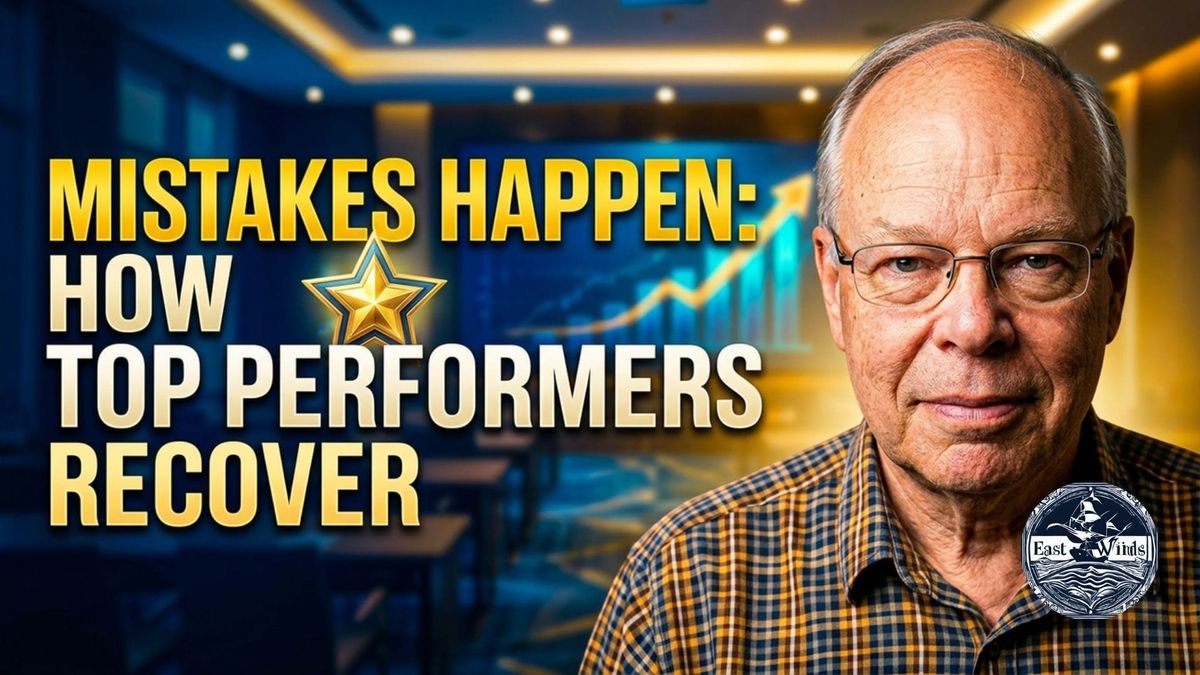
When Mistakes Happen: How Top Performers Recover | Mitch Weisburgh
Mitchell Weisburgh shares the neuroscience behind conflict — and a 4-step framework that turns triggered reactions into real resolution. Free toolkits included

Hosts: Percy Barr, Wayne Pratt and Bernie Franzgrote
Mitchell Weisburgh shares a 4-step conflict framework on East Trade Winds. Learn how curiosity, tone, and neuroscience turn conflict into resolution. Free toolkits included.
GROWTH CATEGORY: Leadership & Ops
Most people walk into a conflict and immediately try to fix it. That's the mistake.
When someone is triggered, they are not ready for your solution. They need to feel heard first. Mitchell Weisburgh has spent years teaching people — and the teams they lead — how to make that shift.
In East Trade Winds Season 3, Episode 033, Mitchell walked the community through a practical, neuroscience-backed framework for handling conflict. And he brought two free toolkits to give away on the spot.
Watch the full conversation here:
WHO THIS IS FOR
SMB owners / Solopreneurs / Corporate escapees / Leaders building systems
If you manage customers or lead a team, this session is built for you.
Key Lessons
1. Curiosity is the first move — not solutions
When conflict hits, the survival brain takes over. The prefrontal cortex — where reasoning lives — goes offline. Trying to solve anything in that moment is wasted effort.
Mitchell's framework starts with one shift: get curious. Not curious as a tactic. Genuinely curious about what the other person is experiencing. Once you're in that mode, you stop defending and start connecting. That's when the conversation can actually move.
2. Your tone of voice is doing most of the work
Humans have mirror neurons. When you speak in a slow, calm, steady voice, the person across from you has a biological urge to match it. Their nervous system begins to co-regulate with yours.
ETW community member Joseph described slowing his voice down deliberately in high-tension calls — and watching the other person's pace drop to match his. That's not a communication trick. That's neuroscience in action.
3. Prepare the response before the conflict arrives
When you're in the middle of a conflict, you're in your limbic brain. You react from what you already know. If curiosity and calm questioning aren't already in your muscle memory, they won't be available when you need them.
Mitchell's advice: think through likely conflict scenarios in advance. Decide your attitude. Rehearse the questions. Run the simulation mentally so that when the moment comes, you already know what to do.
Practical Steps
- Download Mitchell's free toolkits this week. Customer Service Conflicts and Workplace Conflicts — both free, both practical.
- Pick one upcoming difficult conversation and prepare for it in advance. Write down two or three curiosity-based questions before you walk into the room.
- Practice slowing your voice in low-stakes moments. Build the muscle before you need it under pressure.
About Mitchell Weisburgh
Mitchell Weisburgh helps individuals and teams break through the mental barriers that make conflict worse than it needs to be. He is the author of the Mind Shifting series, including Mind Shifting: Conflicting — a practical guide to navigating high-stakes conversations without losing the relationship.
He works with business owners, corporate teams, and leaders who want to stop reacting and start responding.
Visit his website | Connect on LinkedIn
Listen on Audio
Browse all East Trade Winds episodes
FAQ
Q: Do I need to read Mitchell's book to use these toolkits? No. The toolkits stand on their own. Download either one and you can apply the framework to a real situation today. The book adds depth — but the tools work without it.
Q: What if the other person refuses to calm down no matter what I do? Mitchell addresses this directly. Some people are not ready to resolve — and some requests are simply unreasonable. The framework helps you identify that faster, so you can decide how to proceed without wasting energy on a conversation that isn't going anywhere.
Q: Is this only useful for customer-facing businesses? No. The same principles apply to internal team conflict, peer disagreements, and leadership moments. Anywhere two people need to reach an understanding, this framework applies.