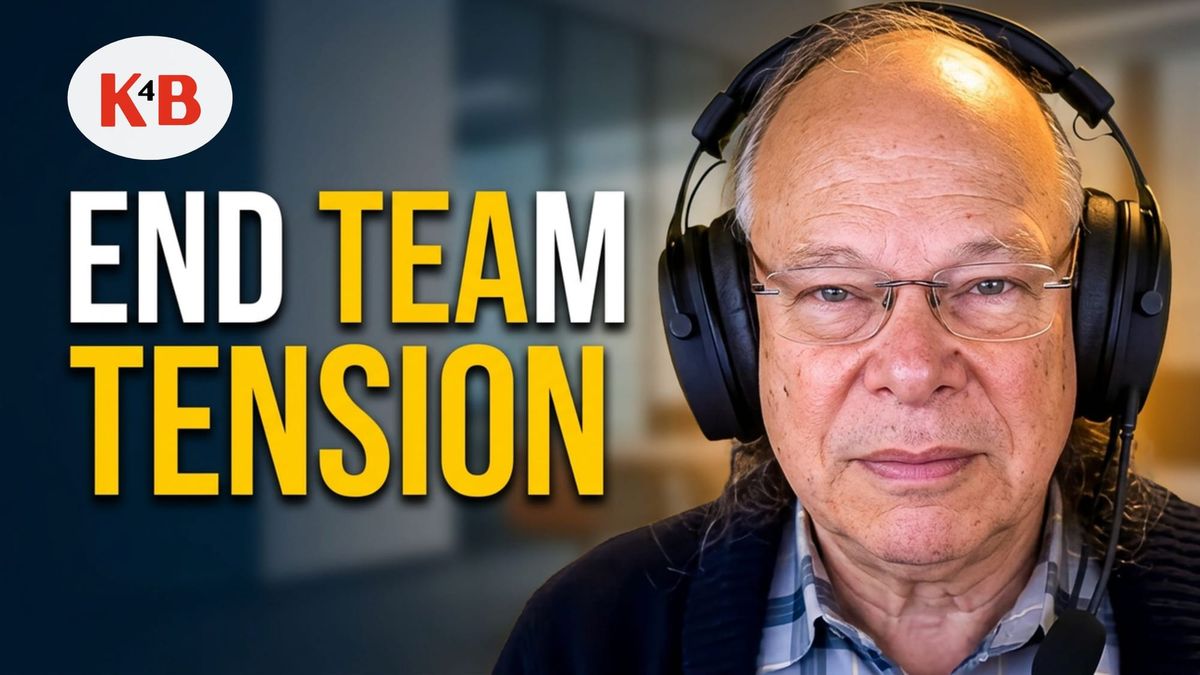
Is Team Conflict Killing Your Business? | Mitch Weisburgh
Mitchell Weisburgh returns to Knack 4 Business to show founders and leaders how to turn conflict into collaboration — with tools, neuroscience, and a framework you can use this week.

Hosts: Bernie Franzgrote + Wayne Pratt
Mitchell Weisburgh returns to Knack 4 Business to show SMB leaders how to turn team conflict into collaboration, better decisions, and real business growth.
GROWTH CATEGORY: Leadership & Ops
Most business owners treat conflict like a fire. Put it out fast, move on, and hope it doesn't start again.
Mitchell Weisburgh spent decades studying why that instinct is wrong — and what the leaders who actually build great teams do instead.
He's back on Knack 4 Business, and this time the conversation is about productive disagreement, the neuroscience of conflict, and a practical system for turning tension into your team's biggest competitive edge.
Watch the full conversation here:
WHO THIS IS FOR
SMB owners / Solopreneurs / Corporate escapees / Leaders building systems
Key Lessons
1. Your brain is not your ally in conflict — until you train it to be.
When pressure hits, your limbic system takes over. Fight, flight, or freeze. Stress hormones flood in and shut down your executive thinking. In that state, you're reacting — not leading. Mitch calls this limbic mode, and the first skill worth building is recognising when you're in it. That recognition alone is often enough to start bringing the stress response down. Pair it with 60 to 90 seconds of deliberate distraction — positive self-talk, breathing, a brief mental redirect — and you can return to clear thinking faster than most people believe is possible.
2. Productive disagreement is a strategy, not an accident.
Mitch spent years working with a consulting partner whose approach was the complete opposite of his own. At first it looked like a liability. Eventually, with the help of a coach, they discovered that the tension between their viewpoints was the engine behind their best work. Clients benefited from solutions that neither of them could have produced alone. The lesson: opposing views, held by people who stay curious instead of defensive, consistently produce stronger outcomes than consensus. The goal isn't to eliminate disagreement — it's to direct it.
3. Preparation is the real conflict skill.
The leaders who handle hard conversations well aren't calmer by nature. They've done the work in advance. Mitch recommends a simple method: before any high-stakes conversation, use an AI tool to script out three versions of how it might unfold. Include the objections, the emotional turns, the moments where it could go sideways. None of those scripts will match the real conversation exactly — but you'll walk in ready for something. And that readiness changes your demeanour, which changes the whole dynamic.
Practical Steps
- Before your next difficult conversation, feed the situation into an AI tool and ask for three versions of how it might go. Script your responses to likely objections. Walk in prepared, not hopeful.
- When you feel your temperature rising, name what's happening internally: this is my survival brain. That single act of metacognition can interrupt the fight-or-flight cycle before it derails you.
- Download Mitch's free toolkits — customer service conflicts and workplace conflicts — and work through the 50 Questions that Change Minds before your next high-pressure interaction.
About the Guest
Mitchell Weisburgh helps individuals and teams move from reactive thinking to constructive collaboration. He is the founder of the MindShifting community, author of Mind Shifting: Stop Your Brain from Sabotaging Your Happiness, and is completing his second book, Mind Shifting: Conflict and Collaboration. Over a career spanning education, corporate training, and nonprofit leadership, Mitch has taught mind shifting to educators, founders, and teams across North America. He writes a weekly newsletter at MindShiftingWithMitch.com and is active on LinkedIn.
Listen on Audio
- Web Indexer chat bot
- Join Canada Growth Network $47 CDN/ mo = GoHighLevel
- Gentry Learning podcast: Property Wizard
- Search K4B episodes by topic using Web Indexer
- Want to be a guest? Register here
FAQ
Q: What is productive disagreement in business? Productive disagreement is conflict that moves a team toward a better outcome than any individual could reach alone. It requires both parties to stay curious, maintain a shared goal, and resist the urge to win the argument rather than solve the problem.
Q: How do I stop reacting emotionally in high-pressure conversations? The first step is recognition — noticing you're in fight-or-flight mode is often enough to begin interrupting it. From there, 60 to 90 seconds of deliberate distraction (positive self-talk, breathing, a mental redirect) allows stress hormones to dissipate so your executive thinking can return.
Q: Can AI really help with difficult workplace conversations? Yes, practically. Before a high-stakes meeting, describe the situation to an AI tool and ask it to script three versions of how the conversation might unfold. You won't predict the exact exchange, but you'll walk in prepared for multiple scenarios — which changes your confidence, your demeanour, and the outcome.
K4B Acknowledgements
Carl Richards — Podcast Solutions Made Simple
Fred Crouch — Gentry Real Estate
Jovan Strika — @Hive
Melanie Webber