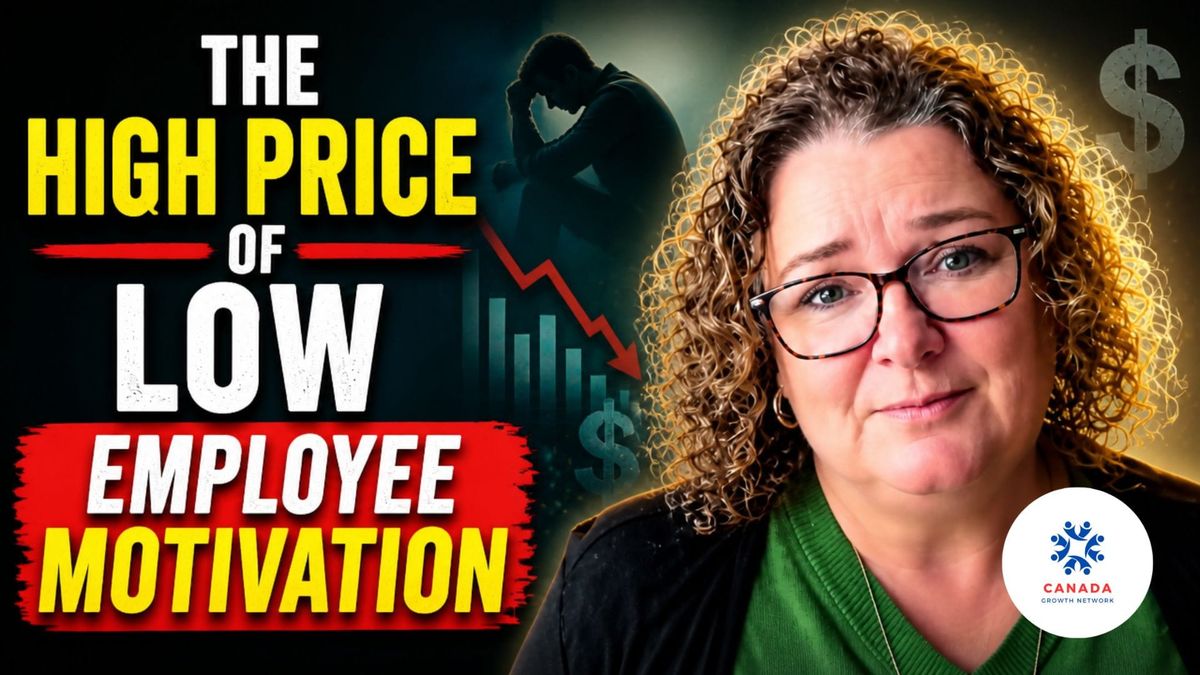
The High Price of Low Employee Motivation | Jessie-Lynn MacDonald
Leadership coach Jessie-Lynn MacDonald reveals why employee disengagement costs $8.9 trillion globally — and how SMB leaders can unlock the human potential already in the room.

Hosts: Percy Barr, Wayne Pratt and Bernie Franzgrote
Leadership coach Jessie-Lynn MacDonald reveals the $8.9T cost of disengagement and how SMB leaders unlock human potential at Canada Growth Network session.
GROWTH CATEGORY: Leadership & Ops
Your processes are clean. Your tools are connected. Your team is technically showing up.
But are they actually there?
Executive and leadership coach Jessie-Lynn MacDonald joins Knack 4 Business to answer that question — and the answer comes with a price tag most leaders aren't tracking.
Watch the full conversation here:
WHO THIS IS FOR
SMB owners / Solopreneurs / Team leaders / Corporate managers building stronger, more engaged organizations
Key Lessons
1. Human potential is the most expensive untracked asset in your business.
A global study cited by Jessie-Lynn puts the cost of employee disengagement at $8.9 trillion annually. That number doesn't live on any balance sheet — but it's being paid. In poor decisions, missed innovation, turnover, and teams that are physically present but mentally somewhere else. One example she uses hits close to home for most leaders: if your average salary is $90,000 and you have 1,000 people, addressing just 10% of the human capacity gap represents $9 million in recovered potential.
2. Paying for 100% and getting 60% is the real efficiency problem.
Jessie-Lynn calls it presenteeism — and it's more expensive than absenteeism because nobody tracks it. People show up. They're at the desk, in the meeting, on the call. But if they're stressed, burned out, or afraid to speak up, they're not bringing judgment, creativity, or clarity. They're going through the motions. For any leader who has sat in a room and felt like nobody was really there — including themselves — this is the number that matters.
3. Leadership presence creates a ripple — in both directions.
Jessie-Lynn worked with three high-performing VPs who were technically exceptional but operating under chronic cognitive overload. Reactive. Narrow in their thinking. The shift came not from another productivity framework — but from strengthening awareness, emotional agility, and a genuine sense that their contribution mattered. When a leader shows up present and psychologically safe, it changes the temperature of an entire team. The reverse is also true.
Practical Steps
- Audit your meetings this week. How many are necessary? What's the real cognitive cost of back-to-back scheduling on your team's ability to think clearly?
- Ask the 1–10 question. Have an honest conversation with yourself — and optionally your team — about what number people are actually showing up at. Name the gap before you can close it.
- Create one moment of psychological safety. In your next team session, model what it looks like to say "I don't know" or "I made a mistake." That single act starts to shift the culture.
About the Guest
Jessie-Lynn MacDonald is an executive and leadership coach who works with leaders and organizations to break through fear, build confidence, and create real change from the inside out. She coaches at the intersection of neuroscience, emotional agility, and practical leadership — helping teams communicate better, lead more clearly, and build workplaces where people actually thrive.
If your organization wants stronger performance without adding more tools, Jessie-Lynn is the person to call.
jessielynnmacdonald.com | LinkedIn
Listen on Audio
FAQ
Q: What does "ROI on human potential" actually mean in practical terms? It means treating engaged, present, psychologically safe employees as a measurable business asset. When Jessie-Lynn runs the numbers — $90K average salary, 1,000 people, 10% capacity gap — that's $9 million sitting untapped. The ROI is real. It just isn't tracked yet.
Q: How is this different from standard HR or wellness programs? Most wellness programs treat symptoms. Jessie-Lynn's approach works at the root — helping leaders understand how they show up, how that ripples through teams, and how to build the conditions where people bring their actual best thinking, not just their physical presence.
Q: Can a small business owner apply this without a coaching budget? Yes. The entry point is self-awareness. Ask yourself — and your team — what number they're showing up at. Create one moment of psychological safety. Audit your meetings. The tools are free. The shift is a decision.
K4B Acknowledgements
With thanks to:
Carl Richards | Fred Crouch | Jovan Strika — @Hive | Melanie Webber