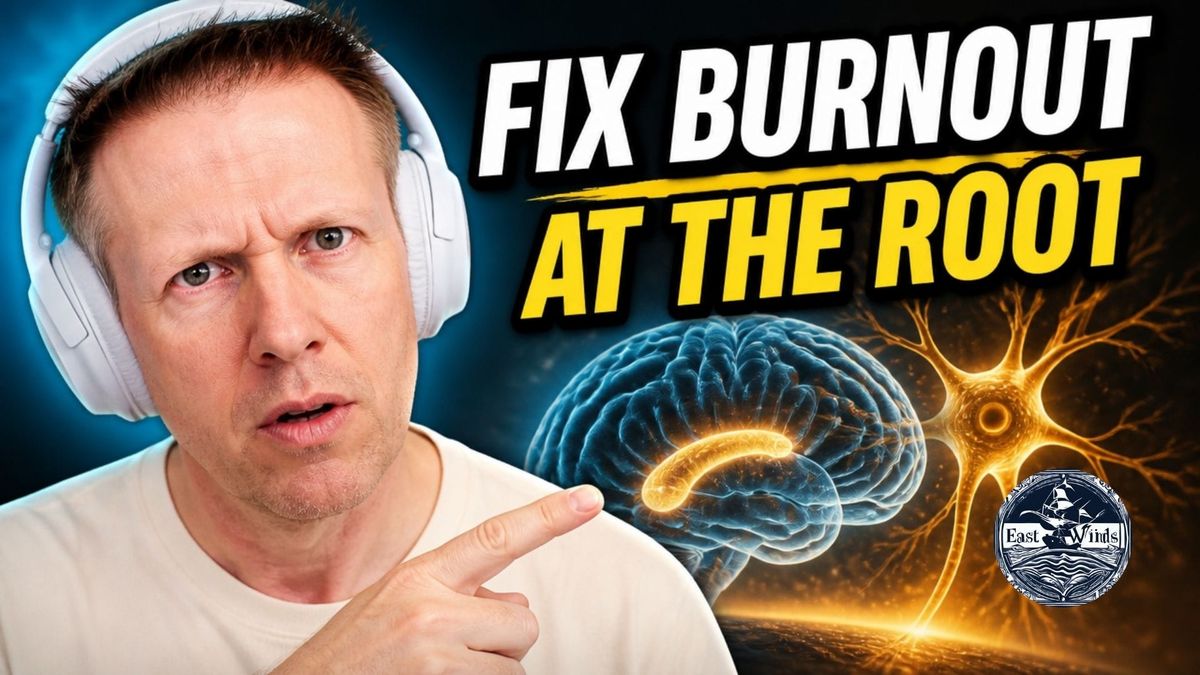
Recovering From Burnout: A Neurological Approach | Blaz Marolt
Blaz Marolt burned out three times — the second cost him six months. In this East Trade Winds session, he breaks down the neuroscience of burnout and the six inputs every business owner's brain actually needs.

Hosts: Percy Barr, Wayne Pratt and Bernie Franzgrote
Blaz Marolt shares a neuroscience-based burnout framework on East Trade Winds. Learn the 6 brain inputs every founder needs to stay functional and recover faster.
GROWTH CATEGORY: Leadership & Ops
Most business owners don't burn out because they're weak. They burn out because they didn't know what their brain actually needed.
Blaz Marolt burned out three times. The second put him on medical leave for six months. By the third, he had a system — built on neuroscience, not willpower. In this East Trade Winds session, he breaks down exactly what happens inside your brain when burnout takes hold, and what it takes to rebuild.
Watch the full conversation here:
WHO THIS IS FOR
SMB owners / Solopreneurs / Corporate escapees / Leaders building systems
If you've ever pushed through exhaustion and wondered why the output got worse instead of better — this session is for you.
Key Lessons
Your brain has a daily production limit — and you're probably exceeding it. Neurologically, your brain can sustain genuine productivity for four to six hours a day. Anything beyond that is degraded performance. Blaz explains this isn't a motivation problem. It's biology. The business owners who protect that productive window consistently outperform those who grind twelve-hour days and wonder why their thinking gets worse by Thursday.
Two missing inputs is all it takes to start the collapse. Blaz's D6 framework identifies six inputs the brain needs to produce healthy neurons: positive relationships, movement, novelty, nature, omega-3 nutrition, and pauses. You can function with one depleted. The moment two go negative simultaneously, a domino effect begins. Blaz lived this: a leadership change at work disrupted his relationships, which increased his hours, which cut his breaks, which ended his Spanish classes, which removed novelty. The cascade took months to play out — and six months to recover from.
Recovery is slower than almost anyone expects — and that's not negotiable. New neurons take up to three weeks to either integrate or die. And 75 to 80 percent of them die before they do their job. Blaz began his recovery protocol in month one. He felt meaningful improvement in month five. That timeline isn't discouraging — it's a map. If you know it ahead of time, you stay in the protocol instead of quitting at month two because nothing seems to be working.
Practical Steps
- Audit your D6 this week. Which two inputs are most depleted right now? Relationships? Sleep? Movement? Start with the two lowest — not all six at once.
- Schedule a real vacation. Not a long weekend. A minimum of seven disconnected days. If you're neurodivergent or carry childhood trauma, add at least three more days to that baseline. Your brain needs longer to complete the same recovery process.
- Protect your peak hours. Identify your four to six sharpest hours. Block them. Move reactive tasks, email, and low-value meetings outside that window. Your best thinking deserves your best brain.
About Blaz Marolt
Blaz Marolt helps founders and operators find the friction inside their business — and remove it before it removes them.
He's a West Point graduate, a former COO, and a Regional Operations Director with experience across eight countries and $100M+ in P&L management. He describes himself as the WD-40 for your business. Find the Friction. Fix the Root Cause. Build to Last.
He is also openly neurodivergent and shares his mental health journey as part of his coaching work — grounded in the belief that until you make the unconscious conscious, it runs your decisions for you.
Connect with Blaz at blazmarolt.com or on LinkedIn. Watch his business content: YouTube — Operations Watch his wellness content: YouTube — Healing with Blaz
Listen on Audio
## Next Steps to Take
- Listen now
- Comment on the LinkedIn page
- Knack 4 Business
- Web Indexer
- Join Canada Growth Network
- Gentry Learning
- Property Wizard
- Subscribe to the K4B blog
- Search K4B episodes by topic
- Want to be a guest? Register here
- Join East Trade Winds free — Tuesdays 8–9 AM EST
FAQ
Why does burnout take so long to recover from? Because recovery depends on neurogenesis — the creation of new neurons. New neurons take up to three weeks to integrate, and 75 to 80 percent die before they do. Real improvement typically takes three to five months of consistent protocol. There is no shortcut through the biology.
Can you prevent burnout while still running a demanding business? Yes — but it requires monitoring the D6 inputs actively, not reactively. The key is catching the moment two inputs go negative simultaneously. That's the trigger point. One depleted input is manageable. Two is where the cascade begins.
What's the single most important thing a business owner can do right now? Sleep. Seven to nine hours, consistently. Not caught up on weekends — nightly. Your brain flushes waste products and builds new connections during sleep. Without it, everything else in the D6 framework underperforms.