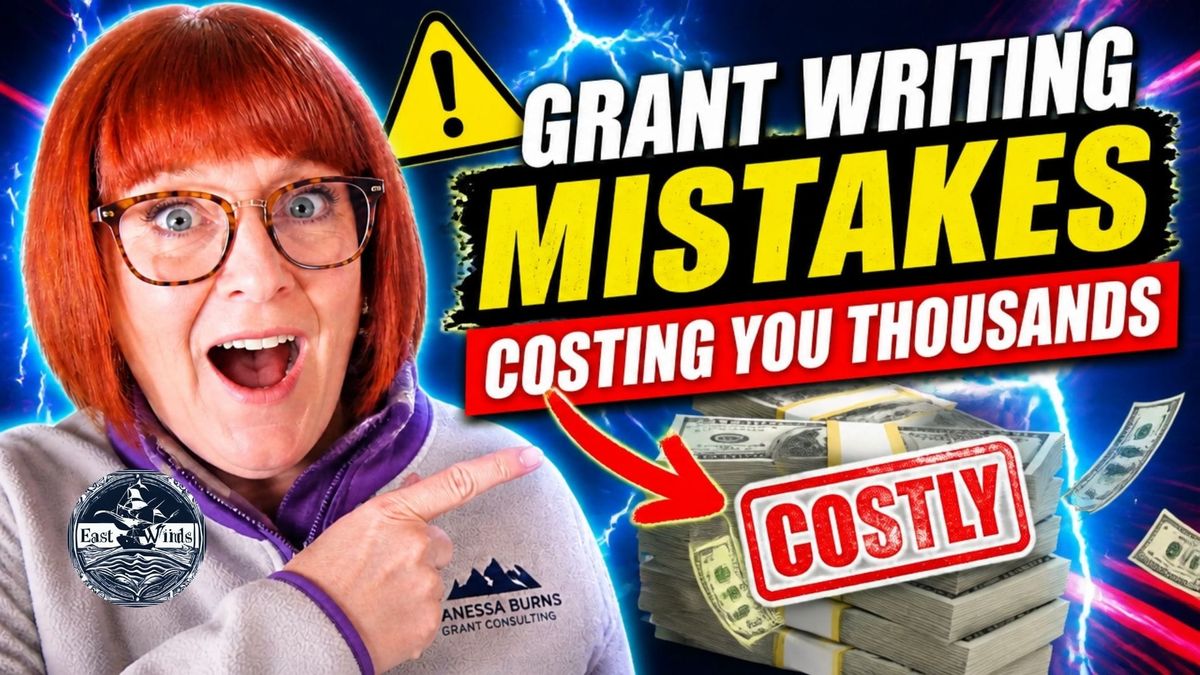
Grant Writing Mistakes That Are Costing You Thousands | Vanessa Burns
Most business owners think grant rejections are about competition. Vanessa Burns says it's about messaging. Here's how to fix it.

Hosts: Percy Barr, Wayne Pratt and Bernie Franzgrote
Grant consultant Vanessa Burns shows small business owners why messaging clarity and alignment are the keys to getting funded — and how to fix both.
GROWTH CATEGORY: Sales & Revenue
Most business owners think they got rejected from a grant because the competition was too strong. Vanessa Burns says the real reason is usually on the first page of your own website.
Vanessa is a certified Grant Professional Consultant based in Halifax, Nova Scotia — one of only six people in Canada holding the GPC accreditation, which is the equivalent of a CPA in the grant world. She joined East Trade Winds Season 3, Episode 037 to break down the mistakes that keep small businesses out of the funding they qualify for.
If you have ever filled out a grant application and wondered why you keep hearing no, this one is for you. Canada Growth Network members deal with exactly these kinds of revenue and growth strategy questions every week — it's the kind of community where this conversation keeps going after the session ends.
Watch the full conversation here:
Who This Is For
SMB owners / Solopreneurs / Grassroots organization leaders / Early-stage founders exploring alternative funding
Key Lessons
Lesson 1: Clarity Is Your Most Valuable Currency
If you cannot explain what your business does in two sentences, you are not ready to apply for a grant. That is not an opinion — it is a pattern Vanessa has seen repeat itself across hundreds of applications.
Funders make decisions in 30 seconds or less. If your website, your pitch, and your application are all saying something slightly different, that inconsistency reads as risk. Jargon, unfocused messaging, and trying to serve everyone all signal the same thing to a funder: this business doesn't know what it is yet.
The practical test Vanessa recommends: hand your website to someone who knows nothing about your industry. If they cannot tell you what you do and who you help, fix that before you write a single word of a grant application.
Lesson 2: Alignment Is the Only Word That Matters
Vanessa used the word alignment more than any other in this session — and she meant it as a filter, not a buzzword. Does this grant fund what you actually need? Does your business fit the sector and applicant profile the funder targets? Are you already doing this work, or are you creating something new just to qualify?
Funders can tell the difference. The strongest applications come from businesses that are already in motion — they just need capital to move faster. If you are stretching your mission to fit a grant, you are spending time you will not get back.
A key reality check she added: some grants only cover 50% of costs. Some don't pay out until the project is complete. You need real revenue to bridge those gaps. Grants support growth. They do not replace sales.
Gentry Learning is worth exploring if you want structured support on the business fundamentals — messaging, positioning, and the kind of clarity that makes grant applications stronger.
Lesson 3: The Grant Calendar Changes Everything
Most business owners are reactive in the grant space. They see an opportunity, panic, rush an application together, and wonder why it didn't land. Vanessa's answer is a grant calendar — a simple spreadsheet tracking grant names, deadlines, funders, what they cover, and relevant website links.
Cyclical grants — government hiring programs, accessibility funding, export development streams — come back every year. If you know they're coming, you can prepare. Your application is stronger, your materials are aligned, and you are not writing under pressure.
Practical Steps
- Audit your messaging this week. Ask someone outside your industry to read your website. Can they explain what you do and who you help? If not, that is your first priority — before any grant application.
- Read the applicant guide before you apply. Vanessa was direct: read the whole thing. It tells you exactly what expenses are covered, what profile they are funding, and what they expect to see. Skipping it is the fastest way to disqualify yourself.
- Start a grant calendar today. Open a spreadsheet. Add columns for grant name, deadline, funder, funding focus, and website. Start with two or three grants you already know about. Build from there.
About Vanessa Burns
Vanessa Burns helps small businesses and grassroots organizations get clear, confident, and strategic about funding. With 20+ years of fundraising experience and the GPC accreditation — one of six in Canada — she brings both the technical expertise and the practical perspective of someone who has reviewed applications from the funder's side.
She offers training, workshops, mentoring, and full hands-on support. She is also an approved trainer with the Grant Professionals Association.
Vanessa Burns Consulting | LinkedIn Free offer: 30-minute consultation — connect via her website or LinkedIn directly.
Listen on Audio
Browse all East Trade Winds episodes
- Join Canada Growth Network — $1 CAD first month, $47/month after
- Try Web Indexer — search K4B episodes by topic, 24/7
- Gentry Learning | Property Wizard Podcast
- Search all K4B episodes by topic
- Want to be a guest? Register here
- Join East Trade Winds free — Tuesdays 8–9 AM EST
FAQ
Q: Do I need to be generating revenue before I apply for a grant? In most cases, yes. Many grants require financial statements, and funders view early-stage businesses with no revenue as higher risk. Some grants exist for newer businesses, but the pool is smaller. Getting some revenue generation in place first strengthens almost every application.
Q: How do I know if a grant is actually worth applying for? Calculate the ROI before you start. If the grant is worth $5,000 and the application takes 40 hours, ask yourself honestly whether that is the best use of your time right now. Vanessa recommends prioritizing grants where the effort is proportional to the award — and where the alignment with your business is strong.
Q: What is the applicant guide and why does it matter? Every grant has one. It is the official document that explains exactly what the grant covers, who qualifies, what expenses are eligible, and what the funder expects to see in the application. Vanessa was direct: read the whole thing before you write a single word. It is the difference between a strong application and one that misses the mark entirely.